Spray-Dried vs. Liquid Liposomal Ingredients: Which Format Fits Your Product?
Choosing between spray-dried and liquid liposomal ingredients affects formulation design, manufacturing compatibility, storage, and distribution. Although both formats use phospholipid-based delivery systems, their handling requirements and suitability for different dosage forms can vary. Selecting the right format early helps buyers assess technical fit and total cost before moving into formulation trials or commercial production.
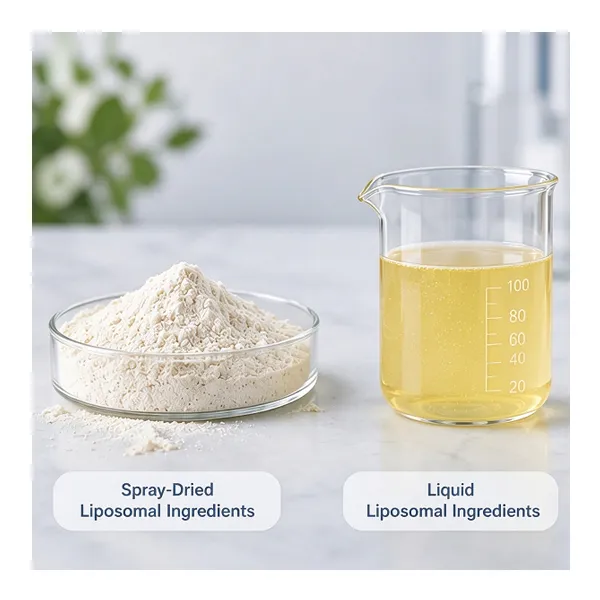
What Is the Difference Between Spray-Dried and Liquid Liposomal Ingredients?
At a foundational level, both formats rely on phospholipid-based encapsulation to protect and deliver active ingredients. The difference lies in physical state, processing history, and intended application.
Spray-dried liposomal ingredients are produced by drying a liposomal formulation into a powder, often with the aid of protective carriers such as maltodextrin or gum acacia. The resulting powder can be easier to handle, transport, and incorporate into solid dosage forms. However, the extent to which liposomal characteristics are retained after drying and restored upon reconstitution should be verified using formulation-specific data.
Liquid liposomal ingredients are pre-hydrated liposomal suspensions dispersed in an aqueous medium. They are formulated to be ready for direct use in liquid applications—beverages, shots, syrups, and dropper products—without a reconstitution step.
The key commercial difference is straightforward:
Spray-dried powders can simplify handling and shipping and are often suitable for capsules, tablets, sachets, and dry blends. Liquid formats can reduce the need for a reconstitution step when developing beverages, shots, and dropper products. Actual performance depends on the formulation, manufacturing process, packaging, and storage conditions.
For either format, buyers should request relevant data on active content, particle characteristics, encapsulation efficiency, and stability. The term "liposomal" alone does not establish product quality or performance.
Spray-Dried Liposomal Powders: Best for Capsules, Sachets, and Powder Blends
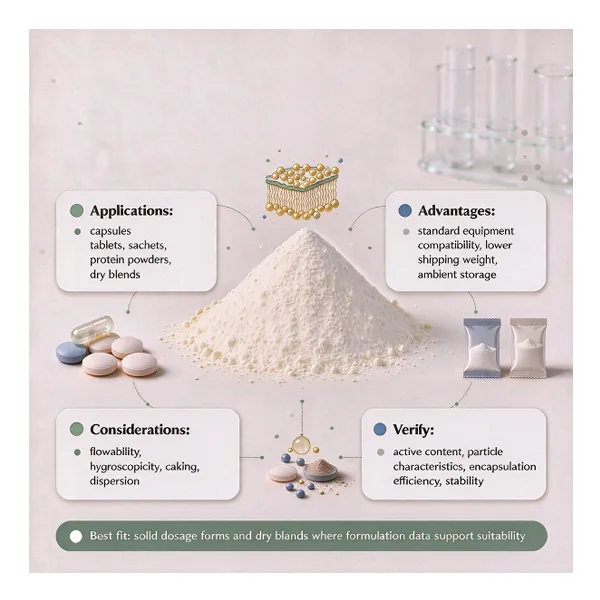
Spray-dried liposomal powders are often considered for solid dosage forms and dry blends. Their suitability depends on powder flow, moisture sensitivity, blend uniformity, active content, and whether the liposomal characteristics meet the requirements of the intended formulation.
Best Applications
Hard capsules (HPMC or gelatin)
Tablets and compressed formats
Stick packs and sachets
Protein powders and meal replacements
Functional beverage premixes
Multi-ingredient powder blends
Key Advantages
Manufacturing compatibility: Drop-in compatibility with standard capsule-filling, tablet-compression, powder-blending, and stick-pack equipment.
Logistics: Significantly lower shipping weight than liquid formats; no cold-chain requirement in most cases.
Storage: Ambient storage is typically feasible, reducing warehousing cost and complexity.
Shelf life: Lower water activity can support longer shelf life, though actual shelf life must be validated for each specific ingredient and packaging system.
Formulation Considerations
Flowability: Particle size, moisture content, and carrier selection affect fill-weight accuracy and blend uniformity.
Hygroscopicity: Some spray-dried matrices absorb moisture and may require moisture-barrier packaging.
Caking risk: High-humidity environments can cause powder agglomeration, affecting shelf stability.
Dispersion behavior: If the powder is used in reconstitutable drink mixes, dispersion rate, sediment formation, and clarity should be tested.
Liquid Liposomal Ingredients: Best for Shots, Droppers, and Functional Beverages
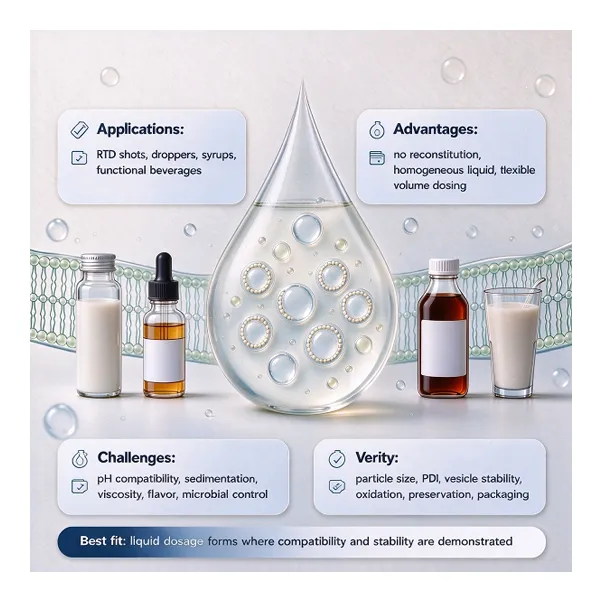
Liquid liposomal ingredients may be suitable for ready-to-drink shots, droppers, syrups, and functional beverages. Because the ingredient is supplied as a liquid suspension, it may reduce the need for a separate reconstitution step. Buyers should still evaluate compatibility with the finished product's pH, processing conditions, preservation system, and packaging.
Best Applications
Ready-to-drink wellness shots
Liquid dropper supplements
Syrups and tonics
Functional and enhanced beverages
Liquid pediatric or senior nutrition products
Premium "ready-to-use liposomal" lifestyle formats
Key Advantages
No reconstitution required: The ingredient is already in aqueous suspension and can be incorporated directly into liquid manufacturing.
Consumer experience: A smooth, homogeneous liquid format can be perceived as premium and is easy to consume.
Dosing flexibility: Liquid formats allow precise volume-based dosing and can be adjusted during formulation more easily than solid-dose systems.
Ready-to-use positioning: Enables "liposomal liquid supplement" product claims and aligns with growing consumer interest in liquid-format nutraceuticals.
Formulation Challenges
Liquid liposomal formulation requires careful technical management. Key challenges include:
pH compatibility: The active ingredient and phospholipid system must remain stable across the product's target pH range.
Sedimentation and clarity: Particle size, PDI, and vesicle stability affect visual clarity and physical stability over time.
Viscosity: Affects mouthfeel, pourability, filling accuracy, and consumer perception.
Flavor masking: Phospholipids and certain actives carry distinct taste profiles that require formulation attention.
Microbial control: Aqueous systems require validated preservation strategies.
Oxidation sensitivity: Polyunsaturated phospholipids are vulnerable to lipid oxidation in liquid environments.
Packaging: Oxygen barriers, light barriers, and fill headspace management are all critical variables.
Stability and Shelf Life: What Buyers Should Verify
Stability should be assessed for the specific liposomal formulation, packaging system, and intended storage conditions. Spray-dried powders generally contain less available water than liquid suspensions, but moisture uptake, oxygen exposure, temperature, and the characteristics of the active ingredient can still affect quality.
Liquid liposomal formulations may require additional attention to oxidation, hydrolysis, particle-size changes, sedimentation, and microbial control. The relevance of each risk depends on the phospholipid composition, active ingredient, pH, preservation strategy, packaging, and storage conditions.
Before selecting a format, buyers should request stability data that identify the tested formulation, packaging, storage conditions, test intervals, and measured quality attributes. Depending on the product, relevant measures may include active content, particle size distribution, encapsulation efficiency, appearance, pH, oxidation indicators, and microbiological quality.
Depending on formulation-specific stability data, liquid products may require oxygen- or light-protective packaging, controlled headspace, defined storage temperatures, or other protective measures. Buyers should confirm these requirements in the supplier's technical documentation and stability data before estimating logistics costs.
Taste, Reconstitution, and Consumer Experience
Consumer experience matters even in B2B ingredient selection, because it ultimately determines whether your finished product succeeds at retail or in subscription channels.
Sensory performance should be evaluated in the finished formulation rather than inferred from ingredient format alone. Liquid liposomal ingredients may eliminate a separate reconstitution step, but taste, mouthfeel, viscosity, color, and aftertaste still require assessment. Phospholipids and certain active ingredients can contribute distinctive sensory characteristics.
The taste and sensory profile of liquid liposomal systems requires formulation investment. Phospholipids can impart a characteristic waxy, fatty, or bitter note. High-load actives such as curcumin, resveratrol, or CoQ10 add their own flavor complexity. Flavor masking, sweetness balance, acidity management, mouthfeel adjustment, color, and aftertaste must all be managed to deliver a consumer-ready product.
For capsules and tablets, direct taste exposure may be limited. For powders used in drink mixes or sachets, buyers should evaluate dispersion, sedimentation, grittiness, and residual flavor in the intended serving volume. Testing should reflect the final recipe and preparation instructions.
Practical takeaway:
Choose liquid liposomal ingredients when immediate consumption and sensory experience are central to your product's positioning.
Choose spray-dried liposomal powders when portability, no-sugar/no-liquid positioning, solid dosage forms, or supply-chain simplicity are the higher priorities.
Manufacturing Fit and Scale-Up
Before choosing a format, confirm that the liposomal ingredient can be processed using the intended equipment and manufacturing conditions.
For spray-dried powders, evaluate powder flow, moisture sensitivity, blend uniformity, fill-weight accuracy, and compatibility with the intended capsule, tablet, or sachet process.
For liquid ingredients, assess mixing conditions, pH compatibility, viscosity, filling accuracy, microbial controls, and packaging requirements. The need for homogenization, degassing, or specific shear conditions should be determined through formulation-specific testing.
Scale-up trials should confirm that relevant quality attributes remain within the agreed specifications at the intended batch size. Depending on the format, these may include active content, blend uniformity, particle characteristics, moisture, pH, appearance, and sedimentation behavior.
Cost Comparison: What Affects Total Cost per Serving?
Cost Factor | Spray-Dried Liposomal Powder | Liquid Liposomal Ingredient |
Ingredient price | Depends on active content, carrier composition, processing, and specifications | Depends on active content, phospholipid composition, concentration, and specifications |
Shipping weight | Usually lower because the ingredient is supplied as a powder | May be higher when water forms a substantial part of the suspension |
Packaging | Packaging should control moisture and other relevant exposure risks | Packaging may need to address oxygen, light, leakage, and formulation-specific requirements |
Storage | Follow the supplier's specified temperature and humidity conditions | Follow the supplier's specified temperature and handling conditions |
Manufacturing | Assess powder flow, blending, fill-weight accuracy, and moisture control | Assess mixing, pH compatibility, filling, preservation, and packaging |
Shelf life | Verify with product-specific stability data | Verify with product-specific stability data |
Additional costs | Reconstitution or dispersion development may be needed for selected applications | Liquid handling, preservation, packaging, or temperature control may add costs |
Best-fit application | Solid dosage forms and dry blends, where formulation data support suitability | Liquid dosage forms, where compatibility and stability have been demonstrated |
Buyer guidance: Compare the estimated cost per finished serving rather than price per kilogram alone. Use comparable specifications and account for active content, required inclusion level, carrier materials, packaging, freight, storage, processing losses, and any additional formulation or testing requirements. Where possible, base the comparison on supplier data and pilot-scale results for the intended product.
Which Format Should Your Product Choose? A Decision Framework
Decision Factor | Consider Spray-Dried Powder | Consider Liquid Liposomal Ingredients |
Target dosage form | Capsules, tablets, sachets, and dry blends | Shots, droppers, syrups, and beverages |
Manufacturing setup | Powder blending and solid-dose production | Liquid mixing and filling |
Handling requirements | Moisture control, powder flow, and blend uniformity | pH compatibility, mixing conditions, and microbial control |
Storage and distribution | Assess humidity, temperature, and packaging requirements | Assess oxidation, light exposure, temperature, and packaging requirements |
Consumer preparation | May require mixing or reconstitution in selected applications | May reduce the need for a separate reconstitution step |
Cost evaluation | Include powder handling and any dispersion development | Include liquid handling, packaging, and any required storage controls |
The final choice should be based on the intended formulation, supplier specifications, stability data, manufacturing capability, and estimated cost per finished serving.
Conclusion
Spray-dried and liquid liposomal ingredients can serve different formulation and manufacturing needs. Spray-dried powders may be suitable for capsules, tablets, sachets, and dry blends, while liquid formats may be considered for shots, droppers, syrups, and beverages. Neither format is universally superior.
Before committing to a supplier or commercial production, buyers should compare active content, relevant particle characteristics, encapsulation efficiency, stability data, processing requirements, packaging, and total cost per finished serving. Sample evaluation and pilot-scale testing can help confirm whether the selected ingredient meets the requirements of the intended formulation.
The most suitable format is the one supported by relevant technical data and compatible with the product's dosage form, manufacturing process, storage conditions, and commercial requirements.
Evaluate the Right Liposomal Ingredient Format
Choosing between spray-dried and liquid liposomal ingredients starts with your target dosage form, processing requirements, and stability expectations.
Contact OriginBio at sales@originbionutra.com to discuss your ingredient requirements and ask about available product specifications, technical documentation, and sample options. Review the relevant data and evaluate formulation compatibility before committing to commercial production.
OriginBio
A reliable one stop nutrition supplement contract manufacturing partner
 EN
 fr
 de
 ru











 Call us on:
 Email Us:
 Office Add:
