Liposomal Ingredients Procurement: A Practical Guide for Manufacturers
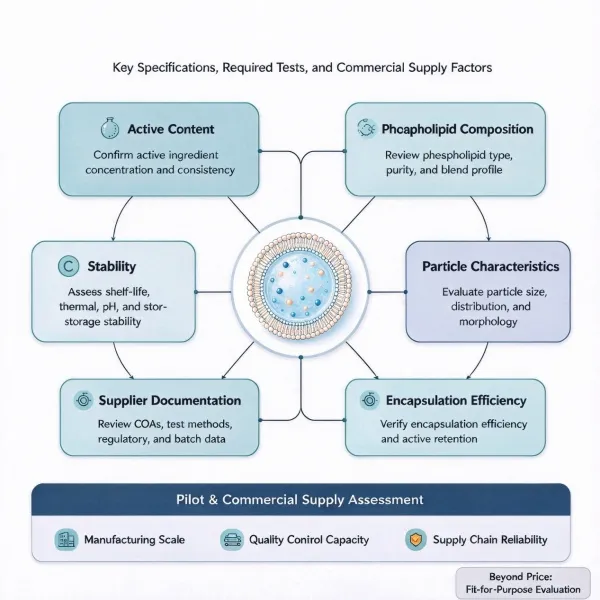
For nutraceutical manufacturers, OEM/ODM companies, and product development teams, sourcing liposomal ingredients requires more than comparing prices. Buyers need to evaluate active content, phospholipid composition, particle characteristics, encapsulation efficiency, stability, and supplier documentation to determine whether an ingredient meets their formulation requirements.
This guide outlines the key specifications to review, the tests to request, and the factors to consider when qualifying a liposomal ingredient supplier for pilot production and commercial supply.
What Are Liposomal Ingredients?
Liposomal ingredients are active substances contained in lipid bilayer vesicles called liposomes, according to nutraceutical science. These tiny spheres are structurally made of phospholipids. Phospholipids naturally form a double layer in aquatic settings because they contain a hydrophilic (water-attracting) head and a hydrophobic (water-repelling) tail. Because of their special structure, liposomes may contain fat-soluble active ingredients within the lipid bilayer while carrying water-soluble active ingredients in their liquid core.
When sourcing these materials, procurement teams must distinguish between three entirely different product categories, which are often mistakenly conflated in the market:
Raw Phospholipids: These are the isolated structural building blocks—such as raw soy or sunflower lecithin. On their own, they are not liposomes; they are simply the starting materials required to build the vesicle.
Phospholipid Blends: These are physical, unreacted mixtures of raw phospholipids and an active ingredient. While they contain the necessary chemical components, they have not been subjected to the mechanical shear or chemical processes required to actually form vesicles.
Finished Liposomal Ingredients: These are true liposomal components. The active ingredient has been successfully and verifiably encapsulated within properly formed phospholipid vesicles.
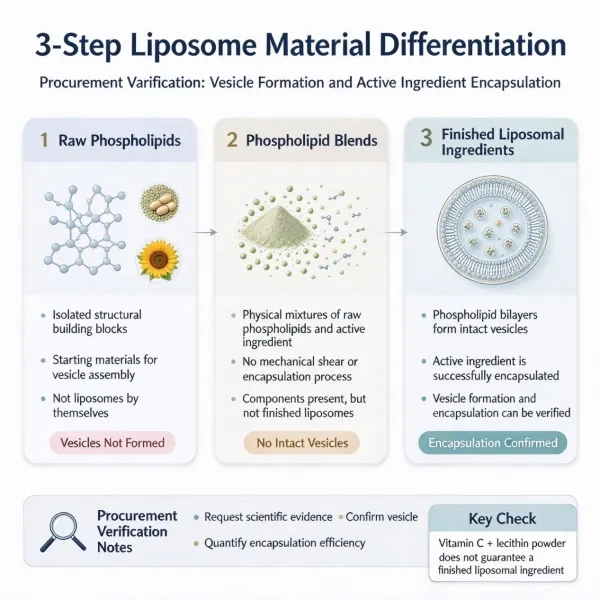
Procurement Note: Verify Liposome Formation and Encapsulation
Adding vitamin C to lecithin powder does not guarantee that a finished liposomal ingredient has been made. Buyers should request scientific proof to ensure vesicle formation and quantify the active ingredient's encapsulation within the recipe. The test methods should work with the given ingredient and transport device.
Common Liposomal Ingredients for Nutraceutical Manufacturing
A broad spectrum of active compounds can be successfully encapsulated into liposomes. When evaluating bulk liposomal ingredients, procurement managers must understand the unique characteristics and formulation challenges associated with different categories:
Ingredient category | Procurement considerations |
Vitamin C | Active content, oxidation control, encapsulation efficiency and stability |
Glutathione | Active content, oxidation or degradation data, taste and odor compatibility |
CoQ10 and alpha-lipoic acid | Solubility, lipid compatibility, active loading and formulation stability |
Botanical extracts | Extract standardization, marker compounds, encapsulation efficiency and batch consistency |
Vitamins D3 and B12 | Content uniformity, dosing accuracy and batch consistency |
Minerals | Compatibility with phospholipids and formulation-specific stability |
Omega-3 fatty acids | Oxidation control, peroxide value and other applicable quality specifications |
Key Specifications to Check Before Purchasing
To thoroughly vet any liposomal ingredient, procurement teams must request a comprehensive Technical Data Sheet (TDS) and a batch-specific Certificate of Analysis (COA). Below are the crucial specifications that define a premium ingredient:
Active Ingredient Content
Verify the active ingredient concentration against the agreed raw-material specification. The supplier should provide a batch-specific Certificate of Analysis (COA) and identify the analytical method used, such as HPLC where appropriate. Confirm that the reported result meets the specification required for your intended formulation.
Phospholipid Composition and Phosphatidylcholine (PC) Content
Phospholipid composition can influence liposome formation, membrane properties, and formulation stability. Buyers should request information on the phospholipid source, composition, and phosphatidylcholine (PC) content where relevant. PC percentage should be evaluated alongside particle characteristics, encapsulation efficiency, and stability data rather than treated as a standalone indicator of quality.
Particle Size and Polydispersity Index (PDI)
Dynamic light scattering (DLS) is commonly used to characterize particle size and size distribution in suitable liposomal dispersions. The polydispersity index (PDI) provides an indication of distribution breadth. Buyers should assess both measurements against formulation-specific specifications and review the test conditions and sample preparation method. Neither particle size nor PDI alone establishes encapsulation efficiency or long-term stability.
Zeta Potential
For suitable liquid dispersions, zeta potential can help characterize surface-charge behavior and interactions between particles. Its relevance to physical stability depends on the formulation and stabilization mechanism. Buyers should interpret zeta potential alongside particle-size distribution, visual observations, and stability testing rather than using a single value as proof of stability.
Encapsulation Efficiency (Free vs. Encapsulated Active)
Encapsulation efficiency (EE) estimates the proportion of an active ingredient that is encapsulated rather than present in the free form, based on a defined analytical method. Buyers should request the reported EE, the method used to separate free and encapsulated fractions, and the supporting analytical data. EE should be interpreted together with active content, product specifications, and stability results.
Stability and Storage Conditions
Liposomal vesicles can be physically fragile. Procurement must request comprehensive stability testing data (real-time and accelerated) to establish the ingredient's shelf life. Pay close attention to temperature, light, and humidity requirements, as these dictate your warehousing and transportation logistics.
Batch Consistency
A single excellent test result is meaningless if the manufacturer cannot replicate it consistently. Protect your supply chain by requesting COAs from at least three different commercial-scale batches to verify batch-to-batch consistency in active content, particle size, and EE.
How to Evaluate a Liposomal Ingredient Supplier
Finding a legitimate liposomal ingredient supplier involves auditing their manufacturing capabilities, quality management systems, and technical expertise. Use the following criteria to evaluate a liposomal ingredients manufacturer before signing a supply agreement:
Quality Certifications: Ensure the facility operates under recognized Good Manufacturing Practices (GMP) and applicable international food-safety systems (e.g., ISO 22000, FSSC 22000, or NSF).
Batch Traceability and Change-Control Procedures: The supplier must maintain absolute traceability from raw material sourcing (such as the origin of the sunflower lecithin) to the finished ingredient. Furthermore, they must have documented change-control procedures to notify you if they alter their raw materials or processing equipment.
Technical Support and Customization: A strong supplier acts as a partner. Do they possess the customization capabilities to adjust the lipid profile, active concentration, or format (liquid/powder) to suit your specific product?
Pilot and Commercial-Scale Production: Can the supplier reliably scale up? Producing perfect liposomes in a 5-liter laboratory beaker is vastly different from maintaining that quality in a 5,000-liter commercial reactor. Verify their scale-up capability.
Documentation Availability: A qualified supplier will readily provide a complete technical dossier, including a TDS, COA, Safety Data Sheet (SDS), stability reports, allergen statements, and comprehensive microbial and heavy-metal testing reports.
Sample Testing and Formulation Qualification
Before committing to a bulk purchase, your procurement and R&D teams must collaborate to qualify the liposomal formulation. Implementing a structured, five-step workflow minimizes the risk of costly manufacturing failures down the line:
Document Review: Thoroughly evaluate the TDS, SDS, and historical COAs. Cross-reference these documents against your brand's specific product requirements, target claims, and local regulatory constraints.
Raw-Material Sample Testing: Request a representative sample (pulled from a commercial batch, not a lab prototype). Conduct in-house or third-party laboratory testing to independently verify active content, microbial limits, heavy metals, and particle size.
Finished-Product Compatibility Testing: Liposomes can react unpredictably with other active ingredients, excipients, and flavorings. Formulate a small benchtop prototype to assess blend uniformity, taste profile, and chemical compatibility.
Stability Testing: Place your benchtop prototype into accelerated stability chambers. You must ensure that the liposomal ingredients can withstand your specific manufacturing processes—such as high-shear mixing, pasteurization, or tableting forces—without the vesicles rupturing.
Pilot and Commercial-Scale Validation: Run a pilot batch through your actual manufacturing equipment. This validates flowability for powders and pumpability for liquids, ensuring seamless integration before full commercial-scale production.
Liquid or Powdered Liposomal Ingredients?
During liposomal supplement manufacturing, one of the most critical procurement decisions is choosing between liquid and powdered formats. The "best" format depends entirely on your final dosage form, manufacturing equipment, and shelf-life requirements.
Table 2: Comparison: Liquid vs. Powdered Liposomal Ingredients
Feature | Liquid Liposomal Formats | Powdered Liposomal Formats |
Common Applications | Syrups, liquid shots, tinctures, softgels, beverage drops. | Two-piece capsules, powder blends, sachets, gummies. |
Manufacturing Advantages | Eliminates the thermal stress of drying processes; naturally maintains high encapsulation efficiency; easier to flavor uniformly. | May offer storage and transport advantages, depending on formulation; lower transportation costs (no water weight); simple to handle in traditional solid-dose facilities. |
Potential Risks / Disadvantages | Prone to physical separation or aggregation over time; shorter shelf life; strictly controlled storage temperatures required. | Drying processes (e.g., spray drying, freeze drying) subject vesicles to stress, which can alter particle size or cause leakage of the active ingredient. |
Key QC Tests Required | Viscosity, pH, Zeta potential, homogeneity (checking for phase separation). | Flowability, bulk density, moisture content, hygroscopicity, reconstitution particle size. |
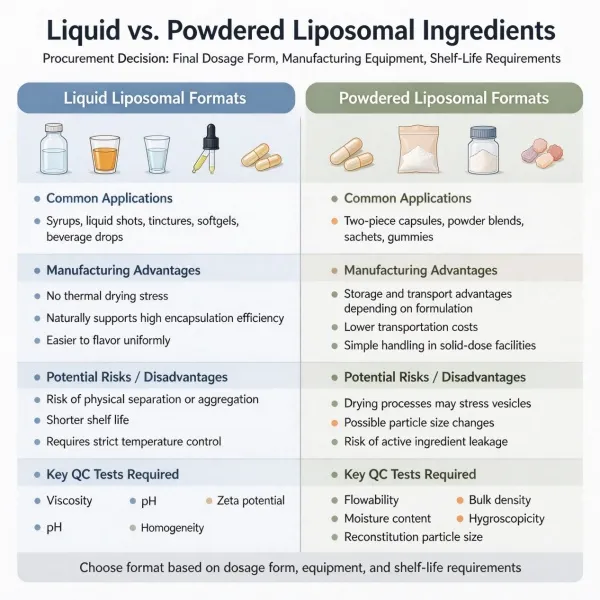
liquid-vs-powder-liposomal-ingredients
Important Note: It is crucial to remember that liposomal ingredients are not universally superior to conventional forms in every single scenario. The performance of any supplement depends on the active ingredient itself, the complexity of the formulation, the chosen dosage form, the precision of the manufacturing process, and its shelf stability. Professional manufacturers avoid making exaggerated claims such as "100% absorption" or "direct delivery to every cell."
Cost, MOQ, and Supply Reliability
In B2B purchasing, fixating purely on the price per kilogram is a strategic error. Procurement managers must evaluate the total procurement value of the bulk liposomal ingredients.
Evaluating True Cost
Price per kilogram alone does not provide a complete basis for comparing liposomal ingredients. Buyers should compare the active content, encapsulation efficiency, required serving level, stability requirements, and applicable quality specifications of each candidate.
Where suitable analytical data are available, calculate the cost per unit of encapsulated active ingredient and account for processing losses, storage requirements, and the amount of material needed to achieve the target formulation. Use comparable specifications and verified batch data when evaluating different suppliers.
Minimum Order Quantities (MOQ) and Lead Times
Negotiate MOQs early. Ensure the supplier’s MOQ aligns with your realistic sales forecasts to prevent capital from being frozen in aging, degrading inventory. Furthermore, clarify lead times from the moment a purchase order (PO) is issued to delivery, accounting for international transit times, customs clearance, and potential supply chain bottlenecks.
Supply Reliability
Assess your supplier’s overall production capacity. Do they have backup supply protocols in place? Reliable manufacturers source their raw phospholipids from diverse geographic regions to hedge against agricultural shortages. Finally, ensure your supply contract includes a mandatory change notification clause, guaranteeing you are informed before any alterations are made to their production methods.
B2B Procurement Checklist
Use the following checklist as a final review tool after completing the technical, quality, and commercial evaluations described above:
 Documentation Verification: Have you received and reviewed the TDS, SDS, and a batch-specific COA?
Active Content Validation: Does the COA state the exact percentage of the active ingredient, validated by HPLC or equivalent methods?
Phospholipid Data: Is the source of the phospholipids (e.g., sunflower, soy) and the precise Phosphatidylcholine (PC) content explicitly declared?
Particle Characterization: Has the supplier provided verified DLS data on particle size and the Polydispersity Index (PDI)?
Encapsulation Efficiency: Has the supplier provided analytical proof distinguishing between free and successfully encapsulated active ingredients?
Safety Testing: Are detailed microbial, heavy metal, and allergen reports included, and do they comply with your local market regulations?
Stability Data: Have you reviewed both real-time and accelerated stability reports for the ingredient?
Batch Consistency: Have you analyzed COAs from at least three different commercial production batches to ensure uniform quality?
Format Compatibility: Is the chosen format (liquid or powder) proven to be physically compatible with your specific manufacturing equipment?
MOQ and Lead Time: Are the MOQs, lead times, and required storage conditions commercially viable for your current supply chain?
Quality Certifications: Is the manufacturing facility independently certified under recognized quality management systems (e.g., GMP, ISO)?
Change Control: Is there a formal, signed agreement that the supplier will notify you of any changes to raw materials or manufacturing processes?
Conclusion
Procuring premium liposomal ingredients is a meticulous, multi-disciplinary process that requires deep collaboration between procurement, R&D, and quality assurance. By moving beyond basic pricing models and demanding rigorous analytical data—such as encapsulation efficiency, precise phospholipid composition, particle size, and comprehensive stability testing—manufacturers can reliably protect their brand reputation.
Taking the time to thoroughly vet your supplier, conduct exhaustive sample testing, and utilize a structured procurement checklist will safeguard your supply chain. Ultimately, this level of diligence ensures your finished nutraceutical products deliver consistent, scientifically validated value to your target market.
Elevate Your Next Product Formulation
Request a technical data sheet, batch-specific COA, product sample, and formulation support for your next nutraceutical project.
Contact OriginBio at sales@originbionutra.com for bulk pricing, MOQ requirements, customization options, and commercial scale-up support.
FAQ
Q1: What is the difference between raw phospholipids and liposomal ingredients?
Raw phospholipids (like lecithin) are simply the structural building blocks. True liposomal ingredients are finished materials where an active compound has been successfully encapsulated inside a phospholipid vesicle using specialized mechanical or chemical processes.
Q2: Why is encapsulation efficiency important when buying bulk liposomes?
Encapsulation efficiency indicates the percentage of the active ingredient actually trapped inside the liposome versus the amount left free in the mixture. A high efficiency rating ensures you are paying for actual liposomes, not unencapsulated raw materials.
Q3: How does particle size affect liposomal formulations?
The size and uniformity (measured by the PDI) of the liposomes impact their physical stability in suspension. Consistent nanoscale or low-microscale particle sizes help prevent phase separation and improve manufacturing consistency.
Q4: Should I choose liquid or powdered liposomal ingredients?
The choice depends on your final dosage form. Liquid liposomes are ideal for tinctures, syrups, and softgels, while powdered liposomes are necessary for dry capsules, tablets, and powdered drink mixes.
Q5: What documents should a liposomal ingredients manufacturer provide?
A reliable supplier should provide a Technical Data Sheet (TDS), Safety Data Sheet (SDS), batch-specific Certificate of Analysis (COA), real-time and accelerated stability data, and reports for heavy metals and microbial limits.
OriginBio
A reliable one stop nutrition supplement contract manufacturing partner
 EN
 fr
 de
 ru











 Call us on:
 Email Us:
 Office Add:
