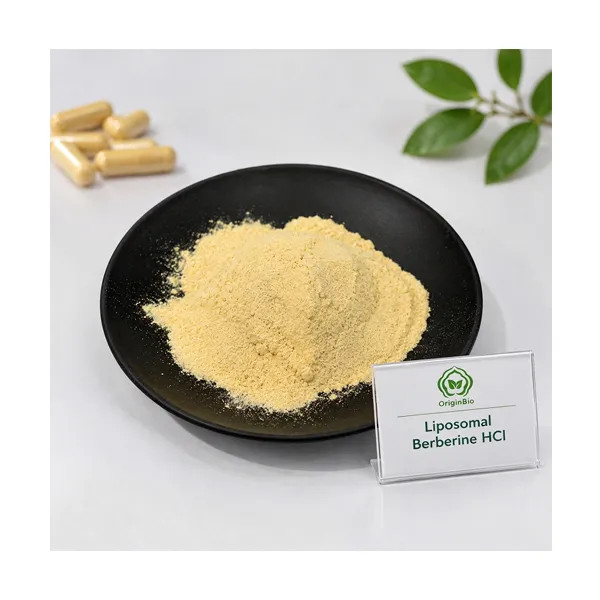
Liposomal berberine HCl works because it solves the biggest weakness of regular berberine: poor absorption. Standard berberine HCl has an oral bioavailability of less than 1%, largely because it gets broken down by stomach acid, pumped back out by intestinal transporters, and metabolized before it ever reaches the bloodstream — a limitation widely documented in pharmacokinetic literature on isoquinoline alkaloids. Wrapping berberine molecules inside a phospholipid liposome shields them from this harsh environment, allowing them to pass through the gut lining more efficiently. The result is a supplement that delivers more active compound to tissues, using a smaller dose, which matters a great deal to brands formulating metabolic health, blood sugar, or cardiovascular support products.
How Liposomal Delivery Works for Berberine HCl?
The Absorption Challenge with Standard Berberine
Berberine is an isoquinoline alkaloid naturally found in plants like Berberis vulgaris and Coptis chinensis. Despite strong research interest for glucose metabolism and lipid support, its molecular structure limits intestinal permeability. Studies tracking plasma concentrations after oral dosing have found extensive first-pass elimination in the liver and gut wall, meaning most of what a person swallows never circulates systemically. This absorption gap is the exact problem liposomal technology was designed to address.
Liposomes as a Protective Carrier System
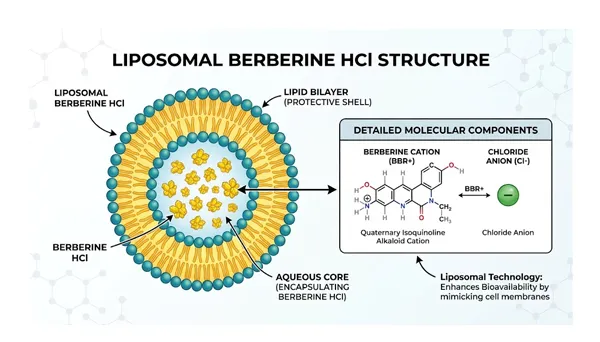
A liposome is a microscopic spherical vesicle built from lipid bilayers that encloses an aqueous core. When berberine HCl is encased within this structure, it becomes physically separated from digestive enzymes and acidic gastric fluid. The lipid shell resembles the structure of human cell membranes, which allows it to merge with intestinal epithelial cells rather than being rejected or degraded[1]. This membrane mimicry is central to why liposomal delivery outperforms plain powders.
Enhanced Cellular Uptake Pathways
Once a liposomal particle reaches the small intestine, it can be absorbed through multiple routes, including direct fusion with enterocyte membranes and lymphatic transport via Peyer's patches, bypassing some first-pass liver metabolism. This dual pathway helps a larger fraction of berberine slip past the barriers that normally block it, giving formulators a practical tool for boosting functional potency without inflating capsule size or dosage frequency.
The Role of Phospholipids in Liposomal Berberine Formulations
Phosphatidylcholine as the Primary Building Block
Most liposomal berberine HCl powders rely on phosphatidylcholine, often sourced from sunflower or soy lecithin, as the structural lipid. Phosphatidylcholine naturally forms bilayers in water due to its amphipathic nature, with a hydrophilic head and hydrophobic tail. This property makes it an efficient, food-grade material for encapsulating water-soluble actives like berberine HCl while remaining gentle on the digestive tract.
Lipid Bilayer Stability and Membrane Compatibility
The quality of the phospholipid directly affects how long a liposome stays intact before reaching the intestine. A poorly formed bilayer can leak its payload early in the stomach, defeating the purpose of encapsulation. Formulators often test the fluidity and transition temperature of the lipid to confirm it remains stable under typical storage and digestive conditions, preserving the berberine until absorption occurs.
Sourcing High-Purity Phospholipids
Not all lecithin is equal. Phospholipid purity, oxidation level, and particle uniformity vary by supplier, which affects the finished liposomal berberine HCl supplement's shelf stability and sensory profile. Manufacturers should request certificates confirming phosphatidylcholine content percentage and peroxide value, since oxidized lipids can produce off-odors and reduce encapsulation performance over time.
Key Factors Affecting Berberine HCl Encapsulation Efficiency
Encapsulation efficiency measures what percentage of berberine actually ends up trapped inside the liposome rather than floating freely outside it. A handful of production variables determine this outcome.
Factor | Impact on Encapsulation |
Lipid-to-drug ratio | Higher phospholipid ratios generally trap more berberine, up to a saturation point |
Hydration method | Thin-film hydration and microfluidic mixing yield different particle uniformity |
Sonication time | Longer sonication reduces particle size but can rupture fragile vesicles |
pH during formation | Berberine's solubility shifts with pH, affecting how much stays bound |
Temperature control | Lipids need to stay above their phase transition temperature during mixing |
Lipid-to-Drug Ratio
Balancing the amount of phospholipid against the amount of berberine HCl is a delicate exercise. Too little lipid leaves excess berberine unencapsulated, while excessive lipid raises production costs without proportional benefit. Most commercial formulations settle on a ratio validated through pilot batches and laboratory assay confirmation.
Manufacturing Method
Thin-film hydration, a classic bench method, produces variable vesicle sizes unless followed by extrusion or sonication. Microfluidic and high-pressure homogenization techniques create more uniform, reproducible liposomes at commercial scale, which is why larger manufacturers increasingly favor these processes for consistent liposomal berberine HCl powder output.
pH and Temperature Control During Production
Berberine HCl solubility and phospholipid bilayer flexibility both respond to pH and heat. Formation typically happens above the phospholipid's phase transition temperature to keep the bilayer pliable enough to close around the berberine molecules, while pH is adjusted to favor ionic interaction between the alkaloid and the lipid membrane surface.
How Particle Size and Dispersion Properties Influence Formulation Performance?
Why Nanoscale Particle Size Matters?
Smaller liposomes, typically in the 50 to 200 nanometer range, tend to cross the intestinal mucus layer more readily than larger micron-sized vesicles. Research on lipid nanocarriers has linked reduced particle diameter with improved cellular uptake and more predictable pharmacokinetic behavior[2], which translates into a more dependable liposomal berberine HCl supplement experience for end users.
Measuring Polydispersity Index (PDI)
PDI reflects how uniform a batch of liposomes is in size. A lower PDI, generally below 0.3, suggests a tighter size distribution and more predictable behavior, while a high PDI signals a mixture of large and small particles that may behave inconsistently in the gut and degrade unevenly during storage.
Stability Over Shelf Life
Liposomes can aggregate, fuse, or leak their contents over months of storage, particularly if exposed to heat or light. Manufacturers track particle size and PDI at multiple time points to confirm the formulation holds up through its intended shelf life, which is a meaningful quality marker buyers should ask about before committing to a supplier.
Why Berberine HCl Content and Quality Testing Matter?
Verifying Active Content via HPLC
High-performance liquid chromatography remains the standard method for confirming exactly how much berberine HCl is present in a finished liposomal powder. Label claims mean little without analytical verification, so reputable manufacturers run batch-specific HPLC assays and share these results with buyers as part of routine documentation.
Heavy Metal and Microbial Screening
Because berberine-containing botanicals can absorb environmental contaminants from soil, raw material batches need screening for lead, arsenic, cadmium, and mercury alongside microbial limits testing. These checks protect both consumer safety and brand reputation, and they are typically required for compliance with import regulations in major markets.
Certificates of Analysis and Traceability
A dependable liposomal berberine HCl powder supplier issues a certificate of analysis for every production lot, covering identity, potency, purity, and microbial safety. Traceability back to raw material origin adds another layer of accountability, which matters increasingly to brands marketing transparency-focused supplement lines.
What Supplement Manufacturers Should Evaluate When Sourcing Liposomal Berberine HCl Powder?
Manufacturing Capability and GMP Certification
Facility standards shape finished product consistency. A production site operating under GMP guidelines, with clean-room classifications and dedicated extraction and encapsulation lines, reduces contamination risk and supports batch-to-batch uniformity, something smaller or uncertified workshops struggle to guarantee at scale.
Customization and Minimum Order Quantities
Brands developing a liposomal berberine product may need to evaluate active content, dosage form, complementary ingredients, packaging, and production volume. The available options depend on the supplier's capabilities and the specific project requirements. Before moving to a pilot or commercial order, buyers should clarify sample availability, minimum order quantities, customization scope, and the specifications that will be used to assess the finished ingredient.
Documentation, Regulatory Support and Sampling
Beyond the physical product, manufacturers should evaluate whether a supplier provides regulatory dossiers, stability data, and labeling guidance suited to target markets. Comprehensive documentation shortens the path from formulation to shelf.
Evaluation Criteria | Why It Matters |
Quality-system documentation | Helps buyers assess applicable manufacturing and quality controls. |
Encapsulation and characterization data | Supports evaluation of the product's measured liposomal attributes. |
MOQ and sample options | Help buyers plan sample assessment, pilot production, and purchasing commitments. |
COA and analytical reports | Allow comparison of reported results with agreed product specifications. |
Stability information | Helps assess whether available evidence supports the stated storage conditions and shelf life. |
Regulatory and sourcing documentation | Helps buyers evaluate documentation needs for the intended product and market. |
Conclusion
Liposomal berberine HCl earns its reputation through a combination of protective lipid encapsulation, controlled particle size, and rigorous quality verification. Each variable, from phospholipid purity to encapsulation efficiency, shapes how much active compound actually reaches circulation. Brands evaluating a liposomal berberine HCl powder supplier should look beyond marketing claims and request analytical data covering potency, particle characteristics, and contaminant safety. These technical details separate a genuinely effective formulation from one that merely carries the liposomal label without delivering measurable absorption benefits.
FAQ
Is liposomal berberine HCl better absorbed than standard berberine?
Research suggests liposomal encapsulation protects berberine from degradation and supports improved intestinal uptake compared to unencapsulated powder, though individual absorption can vary based on formulation quality and particle size.
What phospholipid is typically used in liposomal berberine HCl powder?
Phosphatidylcholine, commonly derived from sunflower or soy lecithin, is the most widely used phospholipid due to its membrane-mimicking structure and food-grade safety profile.
How can brands verify the quality of a liposomal berberine HCl supplement before launch?
Start by reviewing the product specification and applicable batch-specific COA. Depending on the agreed requirements, request supporting assay reports, particle size and PDI data, encapsulation efficiency results, relevant safety testing, and available stability information. Confirm the test methods and acceptance criteria before approving the ingredient for pilot or commercial production.
Discuss Your Liposomal Berberine HCl Requirements with OriginBio
Ready to formulate a dependable liposomal berberine HCl supplement for your brand? OriginBio, a GMP-certified nutraceutical manufacturer and private label supplier, offers low MOQs, sampling support, and full regulatory documentation. Reach our team at sales@originbionutra.com to start your project today.
OriginBio
A reliable one stop nutrition supplement contract manufacturing partner
 EN
 fr
 de
 ru









 Call us on:
 Email Us:
 Office Add:
