ORIGINBIO | DELIVERY TECHNOLOGY SERIES |
LIPOSOMAL DELIVERY
IN FUNCTIONAL NUTRITION
Formulation, Stability and Quality Verification
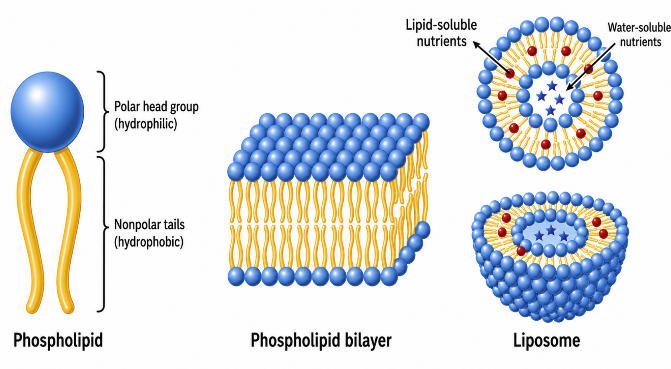
Phospholipid architecture allows liposomes to associate with both water-soluble and lipid-soluble compounds.
Key takeaways
Structure matters Liposomes are phospholipid vesicles with an aqueous interior and one or more lipid bilayers. | Evidence is ingredient-specific A liposomal format should not be treated as a universal guarantee of superior absorption. | Verification is essential Particle size, PDI, encapsulation efficiency, stability and finished-format compatibility must be documented. |
What Is a Liposome?
A liposome is a closed vesicle formed from one or more phospholipid bilayers. Phospholipids are amphiphilic molecules: their polar head groups interact with water, while their non-polar fatty-acid tails avoid it. When dispersed in an aqueous environment, these molecules can self-assemble into bilayer membranes that curve and close into spherical or near-spherical vesicles.
This architecture creates two distinct loading environments. The internal aqueous compartment can accommodate selected water-soluble compounds, while the lipid bilayer can associate with selected fat-soluble compounds. The result is a flexible carrier platform rather than a single fixed formulation.
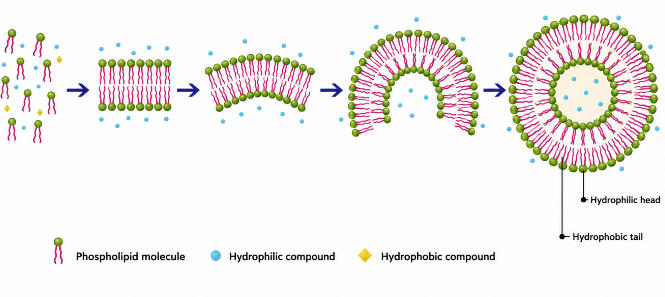
Self-assembly of phospholipid molecules into a closed bilayer vesicle.
| Important distinction A liposome is not simply an oil droplet or an emulsion. It is a vesicular phospholipid structure. Nanoemulsions, lipid nanoparticles and conventional emulsions are related delivery platforms, but they are not interchangeable terms. |
Why the technology attracted attention
Closed phospholipid vesicles were first described in the 1960s and soon became an important model for biological membranes and delivery research. Since then, liposome engineering has expanded from conventional vesicles to long-circulating, surface-modified and stimulus-responsive systems. In functional nutrition, the most relevant commercial questions are usually more practical: can the system improve dispersibility, protect a sensitive ingredient, support a more convenient format and remain stable through shelf life?
Why Use Liposomal Delivery in Functional Nutrition?
Many functional ingredients are difficult to formulate because of low water solubility, oxidation sensitivity, degradation under processing or digestive conditions, or limited compatibility with consumer-friendly formats. Liposomal systems may help address some of these limitations, but the benefit depends on the ingredient, phospholipid composition, manufacturing process and final dosage form.
Protection A phospholipid environment can reduce direct exposure of selected actives to oxygen, light, water or digestive conditions. | Dispersion Liposomal systems may improve the distribution of poorly water-dispersible compounds in aqueous formulations. | Product differentiation When technically substantiated, liposomal delivery can support premium positioning and a clearer formulation story. |
Potential application categories
· Water-soluble nutrients such as vitamin C and glutathione
· Lipid-soluble nutrients such as CoQ10, vitamin D, vitamin K2 and Astaxanthin
· Polyphenols such as curcumin, resveratrol and quercetin
· Selected botanical actives and multi-nutrient systems
How Liposomal Formulations Are Engineered
Liposomes can be classified by the number of bilayers and overall particle size. Small and large unilamellar vesicles contain a single bilayer, while multilamellar vesicles contain multiple concentric bilayers. The most appropriate architecture depends on the active compound, desired loading, release profile, manufacturing route and commercial format.
Commercially relevant production approaches
1. Phase preparation: phospholipids and lipid-soluble components are prepared in a suitable lipid or solvent phase, while water-soluble components are prepared in the aqueous phase.
2. Controlled mixing or hydration: the phases are combined under conditions that promote phospholipid self-assembly.
3. Particle-size reduction: high-pressure homogenization, extrusion or controlled mixing can reduce and narrow particle size.
4. Purification or concentration: free, non-encapsulated material may be separated when required.
5. Format conversion: the dispersion may remain liquid or be converted into a powder through freeze-drying or spray drying with suitable protectants.
6. Final standardization: the system is adjusted to the required active content, phospholipid level, pH and physical specifications.
High-pressure homogenization
High-pressure homogenization is widely used for scale-up because it can process larger volumes and reduce coarse vesicles through shear, turbulence and cavitation. Pressure, cycle number, temperature and formulation composition must be controlled because excessive processing may increase oxidation, leakage or phospholipid degradation.
Microfluidic and controlled-mixing approaches
Microfluidic or micromixer-based approaches can provide tighter control over flow-rate ratio, mixing time and particle formation. These methods are attractive where narrow size distribution and reproducibility are priorities, although throughput, solvent handling and scale-up economics must be evaluated.
The Metrics That Matter
METRIC | WHAT IT TELLS YOU | WHAT TO VERIFY |
Particle size | Average hydrodynamic diameter of the dispersed vesicles | Method, sample preparation, intensity/volume basis and change over shelf life |
PDI | Width of the particle-size distribution | Batch consistency and whether the value remains stable during storage |
Zeta potential | Surface-charge behavior and one indicator of colloidal stability | Measurement medium, pH, ionic strength and formulation context |
Encapsulation efficiency | Percentage of the active associated with or retained by the liposomal fraction | Separation method, assay method and free-active correction |
Active loading | Amount of active relative to the total liposomal system | Usable dose, phospholipid burden and serving-size impact |
Morphology | Shape, lamellarity and structural integrity | TEM, cryo-TEM or another appropriate imaging method |
Stability | Whether the product maintains size, active content and physical integrity | Long-term and accelerated data in the intended packaging and format |
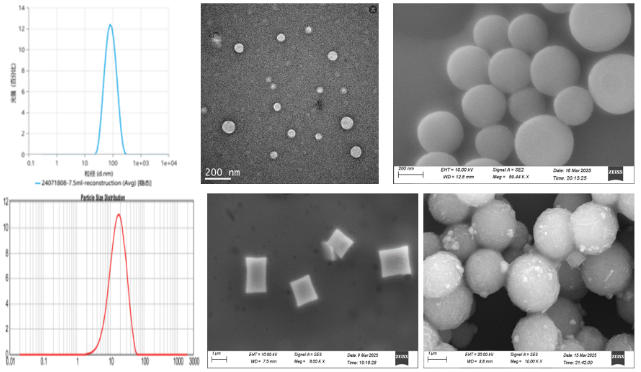
Representative characterization tools may combine particle-size analysis with microscopic imaging.
| Avoid oversimplifying Zeta potential A high absolute Zeta potential can support electrostatic stability, but it is not a universal pass/fail criterion. Neutral or sterically stabilized liposomes may remain stable through mechanisms that are not captured by a single surface-charge value. |
Stability Is the Commercial Test
Liposomal formulations can fail through aggregation, fusion, leakage, sedimentation, phospholipid oxidation or hydrolysis. A system that looks acceptable immediately after production may still change during transport, storage or incorporation into a finished product.
Major stability variables
· Phospholipid source, fatty-acid saturation and transition temperature
· Cholesterol or other membrane-modifying components
· pH, ionic strength and interactions with minerals or charged actives
· Oxygen, light, heat and metal-ion exposure
· Particle concentration and collision frequency
· Packaging headspace, barrier properties and storage temperature
· Conversion from liquid dispersion to powder
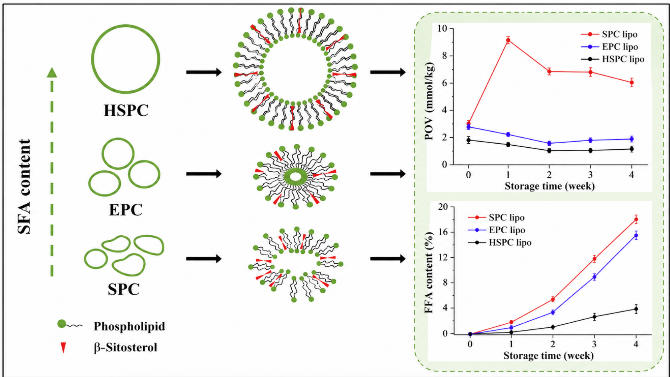
Phospholipid composition can influence membrane packing, oxidation sensitivity and leakage during storage.
Liquid versus powder formats
Liquid liposomal dispersions can simplify processing and may preserve a hydrated vesicle state, but they typically require stronger control of microbial quality, oxidation and physical stability. Powder formats can improve handling and shelf-life potential, but drying is not automatically benign: freezing, dehydration and reconstitution may disrupt the membrane unless appropriate protectants and process conditions are used.
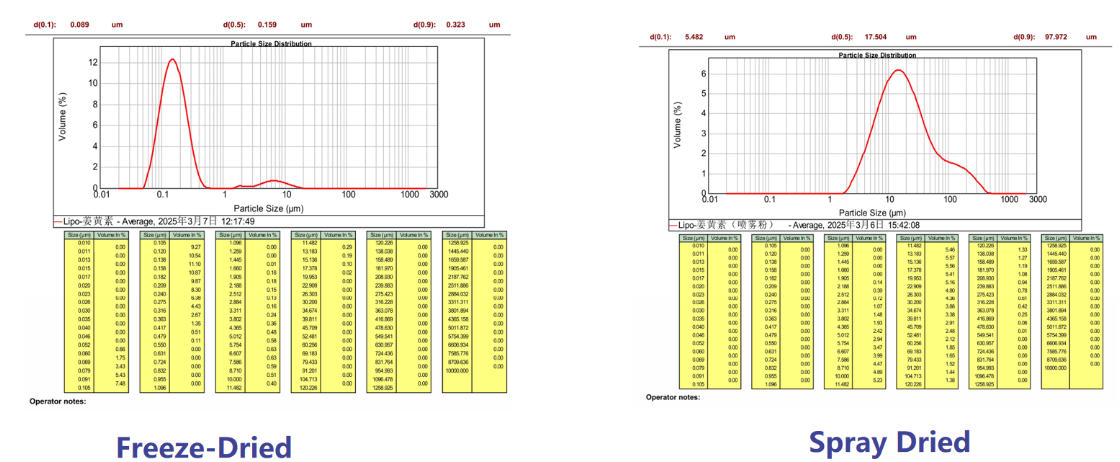
Drying method and protectant system can influence the particle-size distribution after reconstitution.
| Format should be selected early The same liposomal dispersion may behave differently in a liquid shot, capsule, stick pack or powdered beverage. Finished-format compatibility should be evaluated before the commercial formula and packaging are locked. |
06 | WHAT HAPPENS AFTER ORAL INTAKE |
Liposomal Structure Through Digestion
Oral liposomes enter a dynamic environment that changes from the stomach to the small intestine. Acid, salts, digestive enzymes, bile components and food interactions can alter vesicle size, surface properties and membrane integrity. Some systems may retain part of their structure for a period of time; others may reorganize, aggregate or release the active during digestion.
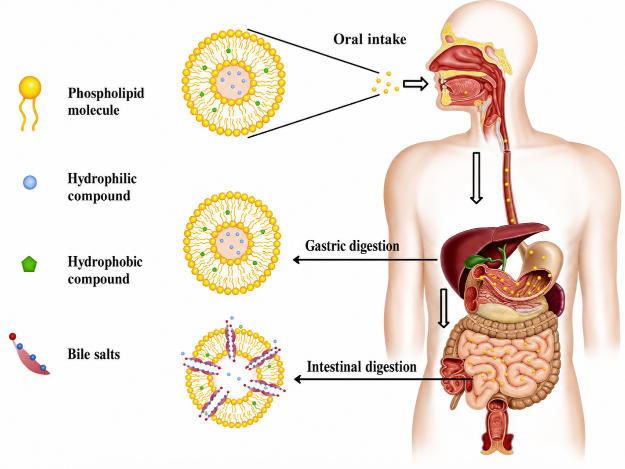
Simplified illustration of structural changes during gastric and intestinal digestion.
For many nutritional formulations, performance may arise from several mechanisms working together: improved dispersion in gastrointestinal fluids, temporary protection of the active, interaction with mixed micelles and bile salts, and altered release or transport. It is therefore more accurate to evaluate the complete formulation than to assume that intact vesicles always travel directly into cells.
Where Liposomal Delivery Fits Best
Liposomal delivery is most compelling when it solves a specific problem that conventional formulation cannot address efficiently. The following categories are frequently explored, but every ingredient requires its own technical and regulatory assessment.
Vitamin C & Glutathione Protection and differentiated oral delivery concepts; verify active stability, free-active content and human evidence. | CoQ10 & Fat-Soluble Vitamins Improved aqueous dispersion and premium delivery positioning; confirm loading and serving-size economics. |
Curcumin, Resveratrol & Quercetin Potential support for low-solubility polyphenols; oxidation and pH stability remain important. | Astaxanthin & Carotenoids Protection from oxidation and light, with improved incorporation into selected aqueous systems. |
Multi-Nutrient systems Possible integration of water- and lipid-soluble actives, although interactions can complicate stability and assay recovery. | Beauty and Healthy-Aging products A strong consumer-facing format when the underlying specifications and finished-product performance are credible. |
Delivery Technology Should Solve a Real Formulation Problem
Liposomal delivery can provide meaningful formulation advantages, particularly for ingredients limited by poor dispersibility, sensitivity or dosage-form constraints. Its commercial value, however, does not come from the label alone. It comes from disciplined engineering, reproducible manufacturing, appropriate characterization and evidence that remains relevant in the finished product.
For brands and procurement teams, the most important question is not “Is it liposomal?” but “What problem does this liposomal system solve, and how has that performance been verified?”
Discuss Your Liposomal Formulation OriginBio supports delivery-system selection, formulation assessment, stability planning, dosage-form design and commercial manufacturing. | SCIENCE → MARKET VALUE |
Selected References
1. Bangham AD, Standish MM, Watkins JC. Diffusion of univalent ions across the lamellae of swollen phospholipids. Journal of Molecular Biology. 1965;13(1):238–252. PMID: 5859039.
2. Gopi S, et al. Evaluation and clinical comparison studies on liposomal and non-liposomal vitamin C. 2021. PMID: 32901526.
3. Ko J, et al. Pharmacokinetic analyses of liposomal and non-liposomal multivitamin/mineral supplements. 2023. PMCID: PMC10347199.
4. Maritim S, et al. Comprehensive analysis of liposome formulation parameters and their influence on particle properties. 2021. PMID: 33161039.
5. Cauzzo J, et al. Characterization of liposomes using quantitative phase microscopy alongside DLS, PDI and zeta-potential measurements. 2021. PMCID: PMC8142990.
6. Sinha R, et al. Oral supplementation with liposomal glutathione elevates body stores of glutathione. 2018. PMID: 28853742.
OriginBio
A reliable one stop nutrition supplement contract manufacturing partner
 EN
EN
 fr
fr  de
de  ru
ru 









 Call us on:
  Email Us:
  Office Add: