Custom Supplement Formulation Process: From Ingredient Selection to Pilot Batch and Scale-Up
A successful supplement formula must do more than look convincing on a specification sheet. It must deliver the intended composition, fit the chosen dosage format, remain suitable throughout its proposed shelf life, and perform consistently in commercial production.
The custom supplement formulation process moves through product definition, ingredient qualification, laboratory development, pilot production, and commercial scale-up. Each stage should resolve specific questions before the next investment is approved.
For supplement brands, this staged approach makes development decisions easier to review. A sample that tastes good may still fill poorly, while a blend that performs well in a small mixer may behave differently during transfer, packaging, or larger-scale processing.
The goal is a documented formula and manufacturing process that can repeatedly produce the agreed product.
How Does Ingredient Selection Establish a Manufacturable Supplement Formula?
Ingredient selection translates a product brief into a defined composition that meets the intended serving, quality, manufacturing, and target-market requirements.
Development should begin with a clear brief rather than a collection of trending ingredients.
Define the Product Before Selecting Ingredients
Describe the intended customer, destination market, dosage format, daily serving, proposed positioning, and target cost. Include dietary restrictions, allergen exclusions, packaging preferences, and any essential sensory characteristics.
A useful brief might specify an unflavored powder with a 10 g serving, a defined ingredient composition, and no added sugar. These are measurable development inputs, rather than a promise that the finished product will achieve a particular health outcome.
Also identify which requirements are essential and which can change. A strict capsule count, for example, may limit the ingredient quantities that physically fit into the product.
OriginBio's custom supplement formulation services provide a starting point for discussing ingredient selection and dosage-format feasibility against a defined product brief.
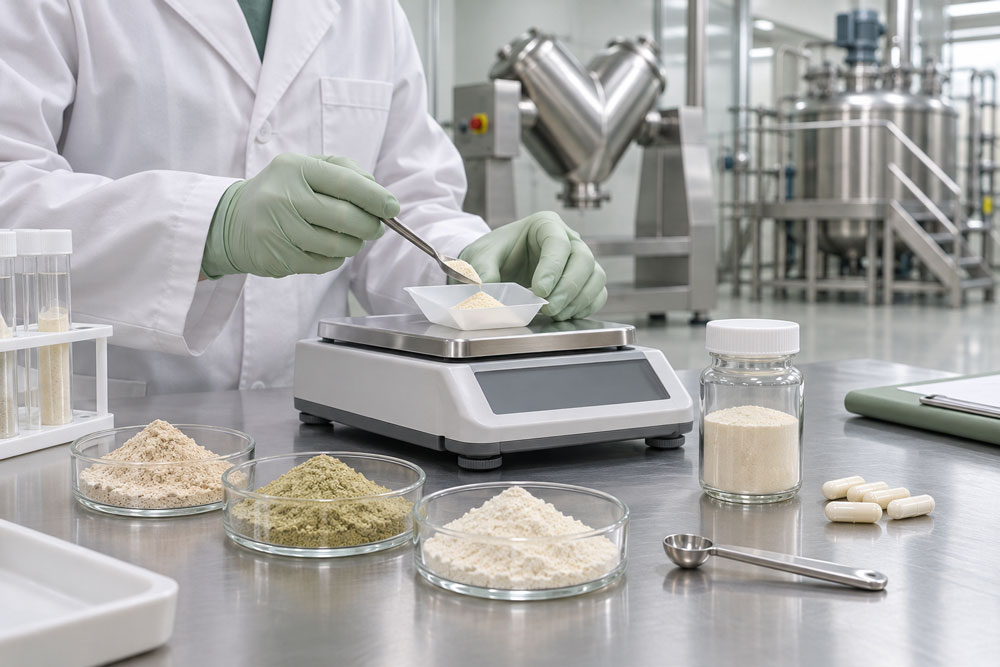
Review Ingredient Identity, Evidence and Market Suitability
An ingredient name alone is insufficient for purchasing or formulation. Depending on the material, the specification may need to define botanical species and plant part, extraction method, chemical form, standardization, carrier materials, or probiotic strain identity.
Review evidence against the proposed ingredient form and serving amount. The FTC's Health Products Compliance Guidance explains that supporting research should be relevant to the advertised product, including whether dosage and formulation are comparable. Adding a researched ingredient does not automatically substantiate every claim for the finished blend.
Check destination-market requirements early. For the United States, where a new dietary ingredient notification is required, the relevant submission must precede introduction into interstate commerce by at least 75 days. FDA's new dietary ingredient guidance for industry explains the applicable conditions. A new combination of ingredients does not automatically require notification merely because the blend is newly developed.
Check Physical Properties and Supplier Specifications
Ingredient qualification should consider both quality and processing behavior.
Particle size, bulk density, moisture sensitivity, flow, taste, and compatibility can affect blending and filling. Materials with substantially different physical properties may separate during handling, creating a uniformity concern that needs investigation.
Distinguish total ingredient weight from the specified component it supplies. For example, 250 mg of an extract standardized to 20% of a marker compound nominally supplies 50 mg of that marker. This arithmetic does not establish effectiveness, and a marker compound is not necessarily the ingredient’s active constituent.
Before laboratory development, agree on the proposed formula, ingredient specifications, supplier documentation, and unresolved feasibility questions.
What Should Lab Samples and Pilot Batches Demonstrate?
Laboratory samples assess formulation feasibility and user experience, while pilot batches assess how the proposed product performs under representative manufacturing conditions.
These stages answer different questions. A hand-prepared sample can help select a flavor, but it cannot establish that a commercial line will mix, transfer, and fill the same formula consistently.
| Development stage | Main question | Typical evaluation | Evidence needed to progress |
|---|
| Ingredient qualification | Are the proposed materials suitable? | Identity, specifications, market status, and physical properties | Defined material requirements and documented review |
| Laboratory development | Can the formula meet the product brief? | Composition, taste, texture, dispersibility, or dosage-format feasibility | Selected formula version and recorded results |
| Pilot production | Can representative equipment process it successfully? | Mixing, transfer, filling, yield, and packaging behavior | Pilot report with deviations and corrective actions |
| Commercial scale-up | Does the larger process meet specifications? | Scale-dependent processing and finished-product quality | Reviewed production records and release results |
| Ongoing production | Does performance remain consistent? | Batch results, changes, complaints, and stability trends | Continued monitoring and controlled changes |
Develop Samples Against Written Acceptance Criteria
Define how samples will be compared before reviewing them.
For powders, assess taste, odor, appearance, dispersibility, sedimentation, and serving volume. For capsules, review fill feasibility and relevant product-performance requirements. Gummies require attention to texture, processing conditions, and ingredient compatibility.
Keep evaluation conditions consistent. Comparing one powder in cold water and another in warm water makes mixing results difficult to interpret.
Assign each formula a version identifier. Record ingredient substitutions, flavor adjustments, serving changes, and the reasons for them. The approved sample must be traceable to a written formula rather than existing only as a physical reference.
Design the Pilot Run Around the Main Risks
A pilot run should investigate the process uncertainties most likely to affect commercial production.
For a powder, these may include mixing order, premix preparation, blender loading, transfer losses, segregation, filling consistency, and powder contamination in seal areas. For gummies, heating and holding conditions may be more relevant.
OriginBio's supplement sampling and pilot production services describe a progression from prototypes to production-condition trials. Confirm which equipment, batch size, tests, and packaging configurations your proposed pilot will cover.
There is no universally correct pilot size. Its usefulness depends on how well it represents the intended process and addresses the identified risks.
Use Sampling to Investigate Uniformity
An acceptable average result can conceal variation between individual samples.
Establish a sampling plan that considers relevant blender locations or the beginning, middle, and end of filling, as appropriate to the process. Define the analytical method and acceptance criteria before testing.
For low-inclusion ingredients, evaluate whether a premix or controlled addition sequence is needed. Neither longer mixing nor a larger number of samples automatically solves a distribution problem.
A single successful pilot provides development evidence; it does not automatically establish that the complete manufacturing process has been validated.
How Does Supplement Scale-Up Move from Pilot Results to Commercial Production?
Supplement scale-up transfers a developed formula to commercial equipment while controlling changes that could affect composition, performance, yield, and packaging quality.
Increasing batch weight is only one part of the work. Equipment geometry, mixing conditions, transfer routes, processing time, and filling speed can all change.
Transfer Process Knowledge Along with the Formula
The production team needs more than ingredient percentages.
The transfer package should describe material specifications, weighing instructions, addition order, premix steps, equipment requirements, operating conditions, sampling points, and acceptance criteria. It should also identify what went wrong during development and how those issues were resolved.
A larger blender may require different operating conditions from the pilot equipment. Replicating the same mixing time without evaluating equipment and loading differences can leave important assumptions unchecked.
Reconcile Theoretical Output with Actual Yield
Simple calculations help separate formula requirements from production losses.
For an illustrative powder containing 10 g per serving, a 100 kg blend contains 10,000 theoretical servings:
100,000 g ÷ 10 g = 10,000 servings
If 95 kg remains available for conforming finished product after recorded sampling, retention, and processing losses, that represents 9,500 servings at the target weight, before further filling losses.
These figures are hypothetical, not recommended yield limits. Actual saleable output depends on fill-weight control and subsequent operations. Investigate unexpected losses rather than automatically increasing ingredient quantities.
Any intentional formulation overage should have a documented technical basis and appropriate review.
Establish Manufacturing Records and Release Requirements
For U.S. dietary supplements, FDA's dietary supplement CGMP guidance explains that 21 CFR 111.205(a) requires a written master manufacturing record for each unique formulation and each batch size. Batch production records document execution of the manufacturing instructions.
Commercial approval should connect the formula to defined specifications, relevant testing, packaging requirements, and quality review. Brand approval of flavor or appearance serves a different purpose from the manufacturer’s quality release decision.
OriginBio's supplement mass production services provide a route for discussing commercial manufacturing after development requirements have been established. Request a written production scope covering materials, testing, packaging, responsibilities, and release documentation.
Confirm Packaging, Stability and Change Control
Evaluate the product in its intended packaging. A sealed development sample may not represent a tub opened repeatedly by customers or a flexible packet exposed to transport conditions.
Establish an appropriate stability program and the evidence needed to support the proposed shelf life. Accelerated testing may contribute to that assessment, but a short trial should not be treated as automatic proof of long-term performance.
After approval, control changes to ingredient suppliers, material grades, formula quantities, equipment, and packaging. Depending on the change, additional trials, testing, or stability assessment may be necessary.
Development schedules should therefore be milestone-based. Ingredient availability, sample revisions, analytical readiness, pilot findings, and packaging procurement determine the actual timeline.
Conclusion
A reliable custom supplement formulation process turns a product concept into a documented formula, a workable manufacturing method, and an evidence-based commercial release decision.
Ingredient selection establishes the composition and material requirements. Laboratory samples refine feasibility and user experience. Pilot batches investigate manufacturing risks, while scale-up confirms how the product performs on commercial equipment.
To discuss a project with OriginBio, provide your target market, dosage format, serving requirements, ingredient preferences, exclusions, expected volume, and packaging concept. Ask for a staged proposal that identifies deliverables, approval criteria, costs, and responsibilities from development through commercial production.
FAQ
What information is needed to start custom supplement formulation?
Provide the target market, intended customer, dosage format, serving size, required ingredients, exclusions, packaging preferences, and expected order volume. Identify which requirements are fixed and which can be adjusted.
What is the difference between a lab sample and a pilot batch?
A lab sample primarily evaluates formula feasibility and product characteristics. A pilot batch investigates performance under representative processing, filling, and packaging conditions.
Does every supplement require the same pilot batch size?
No. Pilot size should reflect the equipment, dosage format, manufacturing risks, and questions the trial needs to resolve.
How long does custom supplement formulation take?
Timing depends on ingredient sourcing, sample revisions, testing, pilot results, and packaging readiness. Request a schedule tied to defined milestones rather than a generic launch estimate.
Can an approved pilot formula change during scale-up?
Changes may be necessary, but they should be documented and reviewed before implementation. Ingredient substitutions or process adjustments can affect specifications, sensory characteristics, testing, or stability.
Does paying for formulation development mean my brand owns the formula?
Not automatically. Formula ownership, exclusivity, access to technical documents, and rights to transfer manufacturing should be defined in the development and manufacturing agreements.
OriginBio
A reliable one stop nutrition supplement contract manufacturing partner
 EN
 fr
 de
 ru









 Call us on:
 Email Us:
 Office Add:
