Private Label vs Custom Formulation vs Ready-to-Use Formula: Which Manufacturing Model Fits Your Supplement Brand?
Choosing a supplement manufacturing model affects your development budget, product differentiation, launch schedule, and long-term control. The right choice depends on what your brand needs to create—and what has already been developed.
Choose an existing formula when it meets your product requirements and launch readiness is the priority. Choose custom formulation when your positioning requires specific ingredients, amounts, or delivery characteristics. Use a private label arrangement when you want a manufacturer to supply finished supplements under your brand.
These options overlap. A ready-to-use formula can become a private label product, and a custom-developed supplement can also be manufactured and packaged under your brand. Understanding that relationship makes supplier proposals easier to compare.
What Do Private Label, Custom Formulation, and Ready-to-Use Formula Mean?
Private label describes a branded supply arrangement, custom formulation describes product development, and ready-to-use formula describes an existing formulation prepared for manufacturing.
Suppliers sometimes use these terms differently. Before comparing prices, confirm whether the proposal covers an existing formula, modifications to an existing formula, or development from a new brief.
Private Label Supplements
Private label supplements are products manufactured by a supplier and sold under another company’s brand. In common industry usage, private label programs often begin with an existing formula, allowing the brand to select labeling, packaging, and available product options.
This approach suits businesses whose differentiation comes primarily from audience focus, distribution, service, or brand identity. However, access to an existing formula does not automatically include exclusive rights.
OriginBio's private label supplement services provide a starting point for brands seeking pre-formulated products under their own branding. Confirm the available formula, packaging options, and documentation for your specific project.
Custom Supplement Formulation
Custom formulation develops or substantially adapts a supplement around a defined product brief. That brief may specify ingredient forms, amounts per serving, dietary restrictions, taste, dosage format, and intended market.
Custom development is appropriate when an existing product cannot meet a meaningful requirement. Examples include removing an unwanted excipient, changing an ingredient combination, or developing a powder with specific mixing characteristics.
Paying for development does not automatically transfer formula ownership. Ownership, exclusivity, manufacturing rights, and access to technical documents require written agreement.
Ready-to-Use Supplement Formulas
A ready-to-use formula is an existing formulation offered as a starting point for production. It can reduce development work when its composition and delivery format already fit the brief.
“Ready-to-use” does not mean stocked finished goods, immediate dispatch, or acceptance in every market. Ingredient availability, packaging, testing, labeling, and production scheduling still need confirmation.
For brands evaluating existing options, OriginBio's ready-to-use supplement formulas offer a route to compare established formulations before requesting new development.
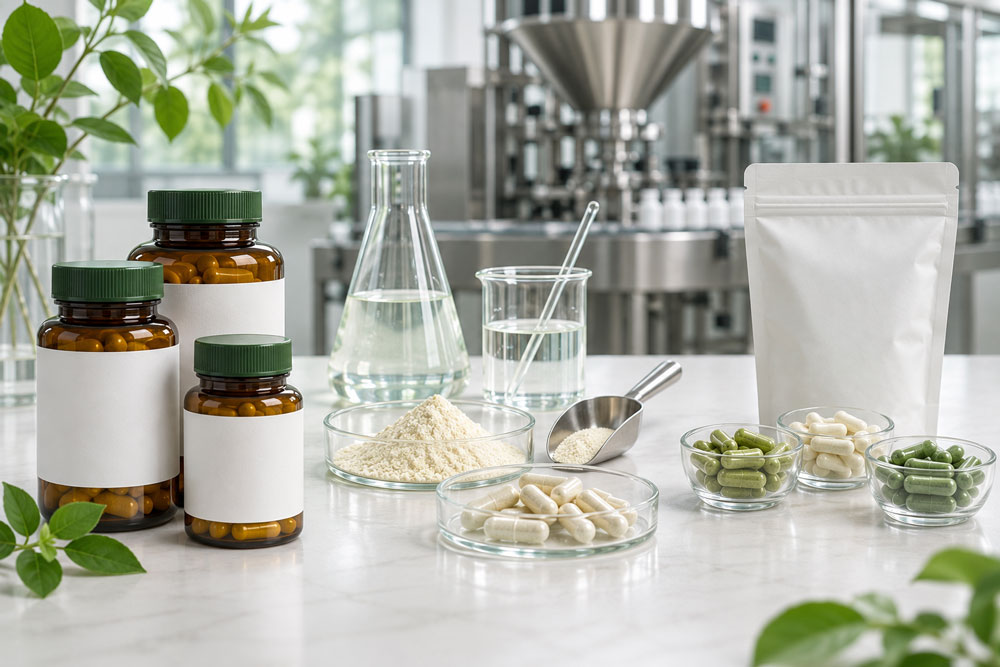
How Do the Three Supplement Manufacturing Options Compare?
The practical difference between these options is how much development, customization, and contractual control your project requires before production.
The table below compares typical arrangements rather than fixed industry rules. Private label and ready-to-use offerings frequently describe different aspects of the same project.
| Decision factor | Private label program | Custom formulation | Ready-to-use formula |
|---|
| Starting point | Supplier product sold under your brand | New brief or substantial formula adaptation | Existing formulation |
| Main benefit | Coordinated branded product supply | Greater control over product specifications | Less formulation development |
| Formula flexibility | Usually limited to available options | Broader, subject to feasibility | Usually limited unless redevelopment is agreed |
| Development spending | Often lower with an unchanged formula | Usually higher because development is required | Often lower when existing documentation remains applicable |
| Launch dependencies | Packaging, materials, testing, and scheduling | Development, sampling, scale-up, testing, and packaging | Formula suitability, materials, testing, and packaging |
| Differentiation | Branding, customer experience, and selected options | Composition, delivery characteristics, and branding | Branding and positioning around an existing product |
| Formula exclusivity | Requires written confirmation | Requires written agreement | Often shared unless otherwise agreed |
| MOQ | Depends on product and packaging | Depends on materials and production requirements | Depends on available production arrangements |
There is no universal minimum order quantity or launch time for any column. A standard capsule with available materials may have different production requirements from a flavored gummy or a softgel using a specialized ingredient.
How Should You Choose and Qualify a Supplement Manufacturing Model?
The best manufacturing model is the least complex route that meets your product specifications, commercial needs, and target-market requirements.
Start with the finished product you need customers to receive. Then determine how much development is necessary to deliver it.
Choose Existing Formulas When the Product Already Fits
An existing formula can suit a first launch, a complementary product, or a new sales channel when its composition already matches the intended positioning.
Review the complete specification before accepting it. Check ingredient identity, amount per serving, excipients, allergens, serving size, packaging, and supporting documents. Changing only the label is straightforward only when the underlying product is suitable.
A small-looking change can create additional work. Replacing a capsule shell, adjusting a flavor, or adding an ingredient may affect processing, testing, or stability evaluation.
Choose Custom Formulation for a Specific Product Requirement
Custom development becomes more useful when you can explain exactly why an existing formula falls short.
For example, “a differentiated wellness supplement” gives a formulator little direction. “An unflavored powder with specified ingredient forms, no added sugar, and a defined serving weight” provides measurable development targets.
Distinguish ingredient weight from active-component content. In a simplified calculation, 200 mg of an extract standardized to 10% of a marker compound provides 20 mg of that marker. The extract identity, assay specification, and relevance of the marker still need review; the calculation alone does not establish clinical effectiveness.
OriginBio's custom supplement formulation services provide a route for discussing ingredient selection and product development. A useful inquiry includes your target market, dosage format, intended serving size, required ingredients, exclusions, and expected order volume.
Apply the Same Quality Expectations to Every Model
An established formula should still undergo an appropriate supplier and product review.
For the U.S. market, FDA's dietary supplement CGMP guidance explains requirements under 21 CFR Part 111, including specifications for components, manufacturing stages, finished products, packaging, and labeling. Choosing an existing formula does not remove applicable quality obligations.
Request documentation appropriate to the product, including agreed specifications, relevant test methods and results, batch traceability, and the basis for the proposed shelf life. Clarify who approves changes and releases finished batches.
Claims also need review. The FTC's Health Products Compliance Guidance explains that health-related advertising claims generally require competent and reliable scientific evidence. A familiar ingredient or an existing supplier formula does not automatically substantiate every proposed benefit claim.
Ingredient status can affect scheduling. Where a U.S. new dietary ingredient notification is required, the applicable submission must precede introduction into interstate commerce by at least 75 days. FDA's new dietary ingredient background guidance explains the requirement and relevant conditions. A newly created blend does not automatically trigger notification simply because its formula is new.
These are U.S. examples; other destination markets require their own assessment.
Confirm Ownership and Responsibilities Before Production
A manufacturing agreement should distinguish your brand assets from the formula and manufacturing knowledge.
Confirm who owns the formula, whether exclusivity applies, which markets or channels it covers, and whether you can transfer production. Also define responsibility for label approval, testing, complaints, recalls, and ingredient substitutions.
Before paying a production deposit, request a written proposal that connects the approved formula to its specifications, packaging, quality requirements, price, MOQ, and production milestones. This gives both parties a clear basis for approval.
Conclusion
Choosing a supplement manufacturing model means matching development depth and contractual rights to your brand’s actual product requirements.
Private label arrangements can simplify branded product supply. Ready-to-use formulas can reduce development work when their specifications already fit. Custom formulation offers greater scope to address requirements that existing products cannot meet.
For a productive discussion with OriginBio, share your target market, product concept, dosage format, ingredient requirements, expected volume, packaging preference, and launch goal. Request a comparison of a suitable existing formula and a custom alternative, with assumptions and exclusions clearly stated.
FAQ
Is private label the same as a ready-to-use formula?
They often overlap. Private label describes supplying products under your brand, while ready-to-use describes an existing formulation that may be used within that arrangement.
Does custom formulation mean my brand owns the formula?
No. Formula ownership, exclusivity, access to technical information, and the right to manufacture elsewhere depend on the written agreement.
Which option is best for a new supplement brand?
An existing formula can be practical when it meets the product brief and reduces development spending. Custom formulation may be appropriate when a specific composition or delivery requirement is central to the brand.
Can I change ingredients in a ready-to-use supplement formula?
Possibly, depending on the supplier and the requested change. Ingredient substitutions or dosage changes may require additional development, testing, and pricing review.
Which manufacturing model has the lowest MOQ?
There is no universal answer. MOQ depends on ingredient purchasing, production requirements, packaging quantities, and whether the supplier offers shared production runs.
What should I send a manufacturer to get an accurate quotation?
Provide the destination market, dosage format, ingredients and amounts per serving, serving count, packaging, expected order quantity, testing requirements, and launch goal. Identify which specifications are essential and which are open to alternatives.
OriginBio
A reliable one stop nutrition supplement contract manufacturing partner
 EN
 fr
 de
 ru









 Call us on:
 Email Us:
 Office Add:
