CoQ10 is an endogenous antioxidant produced in all cells that plays an essential role in energy metabolism and antioxidant protection. Its levels and distribution in the body may be influenced by factors such as age and certain medications, including statins. CoQ10 supplementation has been studied for its potential role in cardiovascular health, exercise performance, and oxidative stress management, although clinical findings vary by population and outcome.
For supplement manufacturers and ingredient buyers, understanding the differences between ubiquinone, ubiquinol, and liposomal CoQ10 is also important when evaluating formulation options, ingredient specifications, and product development requirements.
How Does CoQ10 Support Cellular Energy Production?
A very important part of mitochondrial energy metabolism is coQ10. Most of the energy that cells require for everyday activities is produced by mitochondria.
CoQ10 is in the inner membrane of mitochondria and moves electrons between respiratory chain complexes. It can take electrons from both Complex I and Complex II. After that, it sends them to Complex III.
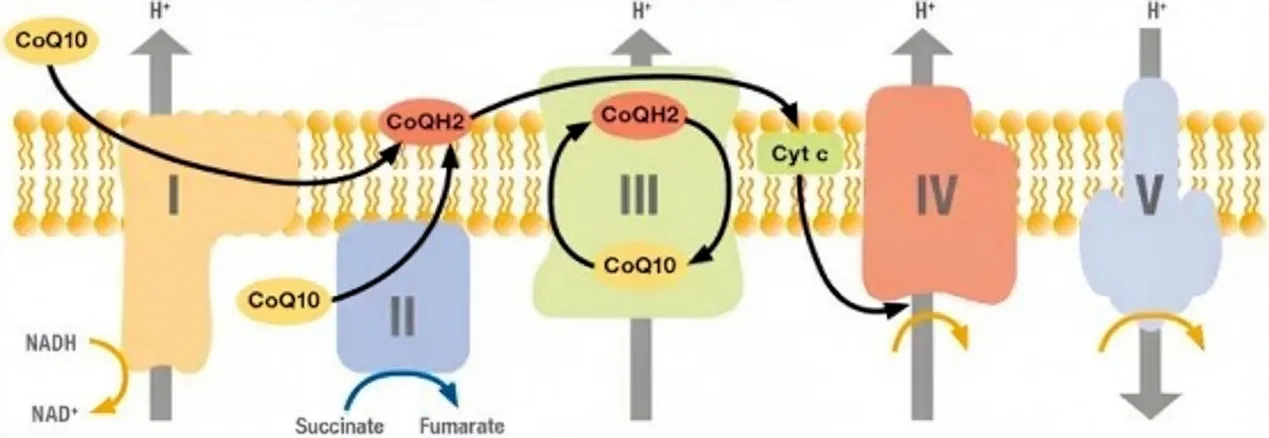
The flow of electrons helps the proton gradient across the inner mitochondrial membrane. This gradient is used by ATP synthase to make ATP.
In this way, CoQ10 directly affects the biological process that makes cells work.
A lot of energy is needed by the heart, skeletal muscles, and other biologically active organs. So, they depend a lot on mitochondrial function working well.
A systematic review done in 2022 looked at 13 randomised controlled trials with a total of 1,126 participants. The researchers found that people who took CoQ10 supplements felt less tired. However, individual responses and study conditions varied. These results don't mean that every consumer will have more energy.
Biological Function | CoQ10's Role | Relevance to Supplement Development |
Cellular energy | Transfers electrons in mitochondrial respiration | Mitochondrial energy support formulas |
Muscle metabolism | Participates in cellular energy production | Sports nutrition and healthy aging |
Antioxidant defense | Helps maintain cellular redox balance | Antioxidant combination formulas |
Cardiovascular function | Supports energy metabolism in cardiac tissue | Heart health supplement concepts |
For supplement manufacturers, CoQ10 offers an established ingredient foundation. However, formulation quality influences its suitability for different delivery systems.
CoQ10 as an Antioxidant: Mechanisms and Evidence
CoQ10 is not just an energy molecule. It is also one of the body's most versatile antioxidants. And the mechanism is unique.
Unique Antioxidant Properties
The reduced form readily donates electrons to neutralise oxidants and displays the strongest antioxidant activity. CoQ10 is the only known naturally occurring lipid-soluble antioxidant that regenerates to its active form in the body.
This regeneration ability is what distinguishes CoQ10 from most other antioxidants. Vitamins C and E, for example, do not regenerate as efficiently. CoQ10 also works synergistically with vitamin E. A vital role in the production of cellular energy combined with its potent antioxidant activity makes CoQ10 an essential health supplement.
Cellular Protection Mechanisms
CoQ10 acts as a potent antioxidant, membrane stabilizer and cofactor in the production of adenosine triphosphate by oxidative phosphorylation, inhibiting the oxidation of proteins and DNA.
This triple function — antioxidant, membrane stabiliser, and ATP cofactor — makes CoQ10 uniquely valuable. It protects cells at multiple levels simultaneously.
Oxidative Stress and Cardiovascular Disease
With age, oxidative stress increases in the human arterial system, and several lines of evidence link oxidative stress and mitochondrial dysfunction in CVD. These observations have led to the hypothesis that supplementation with CoQ10, an electron carrier in the mitochondrial respiratory chain and known powerful antioxidant, could improve cellular bioenergetics in CVD.
Reducing oxidative stress is therefore central to CoQ10's cardiovascular benefit — and the antioxidant and energy pathways reinforce each other.
CoQ10 and Heart Health: What Does the Evidence Say?
The heart requires a continuous supply of energy to maintain its pumping activity. Because cardiac cells contain abundant mitochondria, researchers have investigated CoQ10's potential role in cardiovascular health.
CoQ10 participates in mitochondrial respiration and antioxidant defense. These functions provide a biological rationale for studying its relationship with cardiac function.
Clinical research has examined CoQ10 supplementation alongside conventional treatment for heart failure.
A 2024 meta-analysis included 32 randomized controlled trials involving 3,763 patients. It reported favorable findings for several outcomes, including hospitalization and all-cause mortality. However, many included studies had methodological limitations. Differences in dosage and treatment duration also affected the evidence.
The National Center for Complementary and Integrative Health (NCCIH) also considers the evidence for CoQ10 in heart failure and heart disease inconclusive.
Therefore, CoQ10 should not be presented as a proven treatment or replacement for cardiovascular medication.
For supplement brands, this research supports a more responsible product development approach.
Potential formulation directions include:
Cardiovascular health supplements.
Healthy aging and antioxidant formulas.
Mitochondrial energy support products.
Combination formulas with other nutritional ingredients.
Brands should align product claims with applicable scientific evidence and market regulations.
Ubiquinone vs. Ubiquinol: Which CoQ10 Form Is Better?
CoQ10 exists in two primary forms: ubiquinone and ubiquinol. They differ in their oxidation states, but both participate in the same biological redox cycle.
Ubiquinone accepts electrons and becomes ubiquinol. Ubiquinol can then donate electrons and return to its oxidized form.
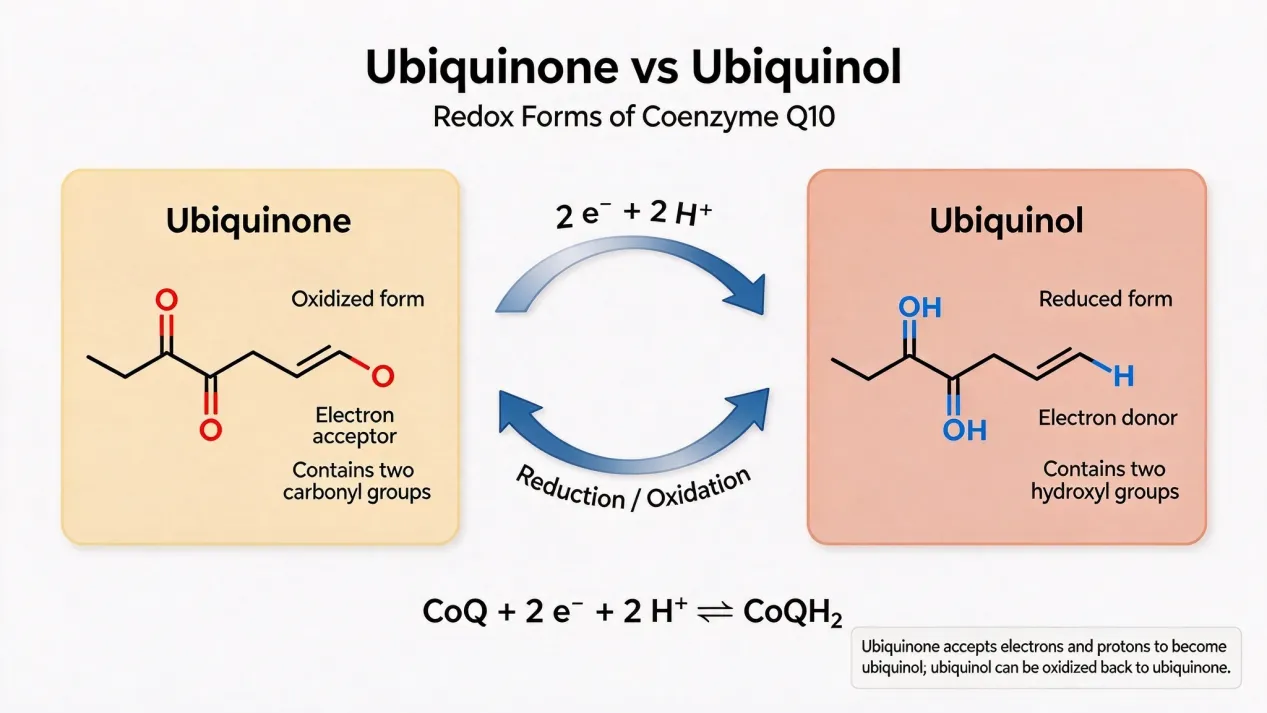
This continuous conversion allows CoQ10 to participate in mitochondrial energy metabolism and antioxidant activity.
Comparison Factor | Ubiquinone | Ubiquinol |
Chemical state | Oxidized form | Reduced form |
Redox activity | Accepts electrons | Donates electrons |
Biological conversion | Can become ubiquinol | Can become ubiquinone |
Main research interest | Mitochondrial electron transport | Antioxidant activity |
Formulation considerations | Assess dispersion and stability | Assess dispersion and oxidation stability |
Which form performs better?
There is no universal answer based on the chemical form alone. Absorption depends on several factors, including formulation, solubilization, dosage, and individual differences.
Some comparative studies report differences in plasma CoQ10 concentrations. However, these findings do not establish one form as universally superior.
For manufacturers, the more practical approach is to evaluate the complete ingredient specification. Consider active content, formulation technology, stability, and intended dosage form.
These factors help determine whether conventional CoQ10 powder or a specialized delivery system better suits the final product.
Liposomal CoQ10: Formulation, Bioavailability, and Quality Factors
CoQ10 has poor water solubility because of its highly hydrophobic molecular structure. This characteristic creates challenges when developing aqueous beverages, powdered drinks, and other water-based supplements. Liposomal technology offers one formulation approach.
What Is Liposomal CoQ10?
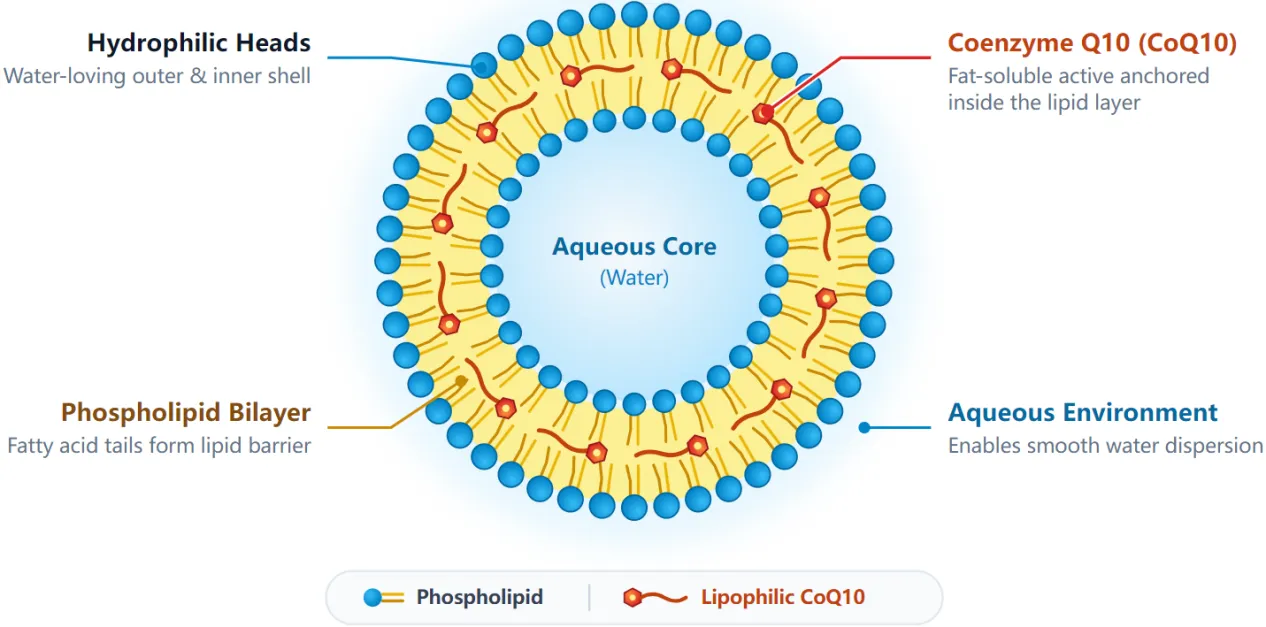
Liposomal CoQ10 encapsulates CoQ10 within phospholipid bilayers, creating microscopic vesicles designed to improve dispersion and absorption efficiency compared with conventional oil-based approaches.
Liposomal encapsulation makes CoQ10 water-dispersible, removing the fat-dependency that limits conventional softgel performance. This means better consistency across consumer populations — regardless of dietary fat intake.
Why Liposomal Delivery Outperforms Conventional Forms
To overcome the slow absorption of CoQ10, various bioavailability enhancement methods have been developed, such as liposomes, polymeric nanoparticles, polymeric micelles, solid lipid nanoparticles, nanostructured lipid carriers, self-emulsifying systems, nanoemulsions, and solid and aqueous dispersions.
Among these, liposomal formulation stands out for a simple reason. Ubiquinol may offer higher initial bioavailability, but liposomal CoQ10 provides more consistent absorption by bypassing solubility limitations. Liposomal CoQ10 often shows more reliable bioavailability because it improves dispersion and enables absorption through endocytosis.
Liposomal CoQ10 attacks the real bottleneck — dispersion and uptake — and delivers measurable absorption gains with the stability of ubiquinone.
OriginBio's Liposomal CoQ10 50% — Product Overview
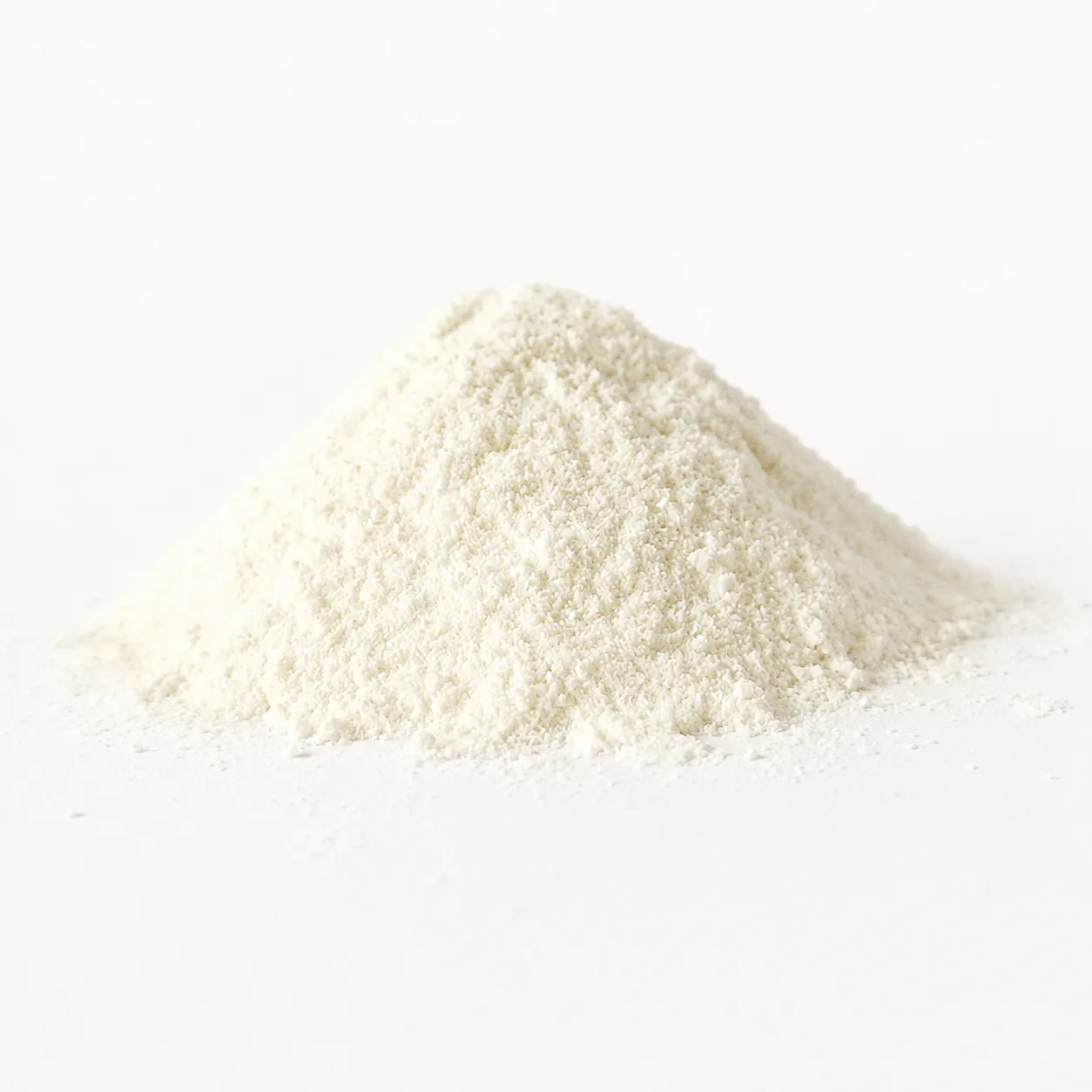
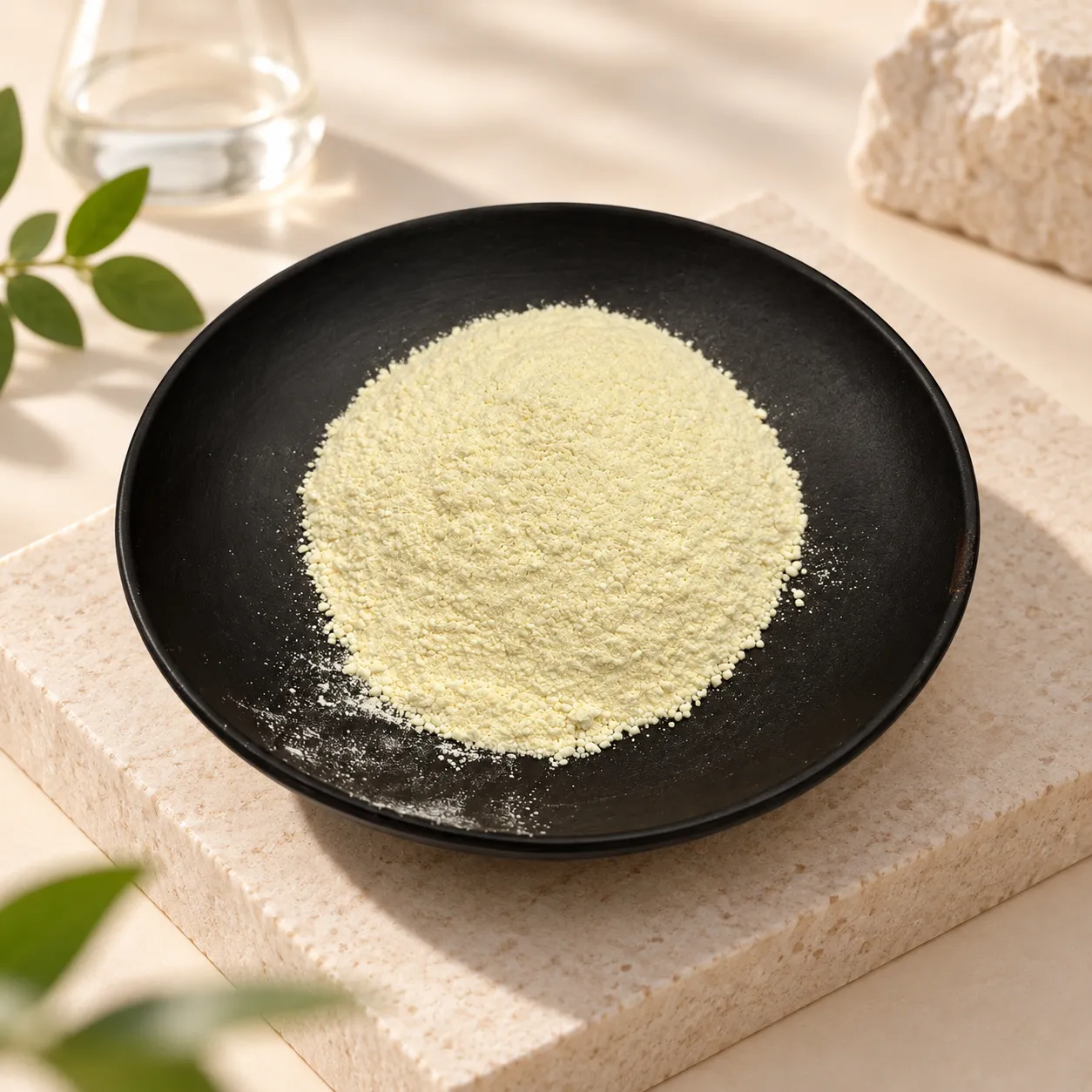
OriginBio supplies Liposomal CoQ10 50% as a high-concentration, standardised bulk ingredient. It is engineered for brand formulators and supplement manufacturers seeking a reliable, GMP-certified raw material.
Specification | Detail |
Product Form | Powder |
CoQ10 Content | 50% (500 mg/g) |
Encapsulation Method | Phospholipid liposomal technology |
Solubility | Water-dispersible |
Recommended Applications | Capsules, sachets, softgels |
Certifications | GMP / HACCP / ISO9001 |
MOQ | 1 kg |
Key Formulation Stability Factors
Factor | Impact on CoQ10 | Recommended Practice |
Light exposure | Accelerates oxidative degradation | Opaque, sealed packaging |
Oxygen | Oxidises active CoQ10 | Nitrogen flushing during fill |
Heat | Breaks down phospholipid bilayers | Low-temperature processing |
Moisture | Affects powder stability | Controlled humidity storage |
Particle size | Influences absorption rate | Tight particle size specification |
Delivery Formats Supported
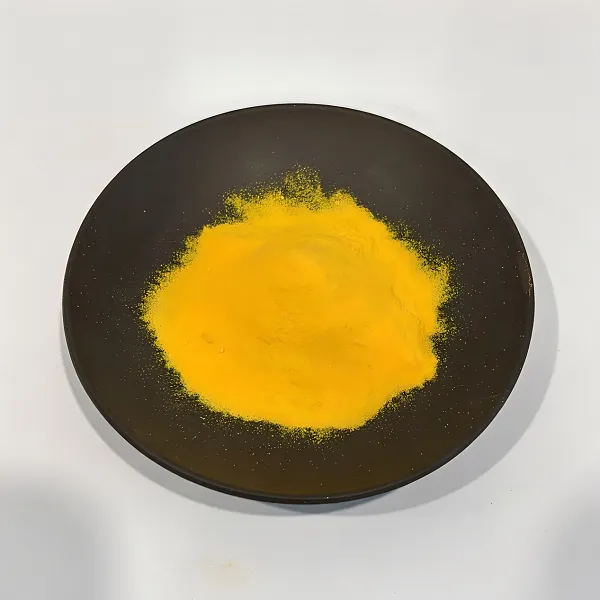
OriginBio's liposomal CoQ10 powder works across a wide range of supplement formats:
Capsules – Flexible dosing; clean label appeal
Softgels – Optimal for lipid-soluble delivery enhancement
Sachets / Drink Mixes – Convenient and water-dispersible
Liquid Sachet – Ready-to-drink, easy to consume
For B2B procurement managers and product developers, the choice between ubiquinone, ubiquinol, and liposomal CoQ10 is not a simple cost comparison — it is a formulation decision with direct implications for bioavailability, stability, sensory performance, and brand positioning.
Conclusion
CoQ10 contributes to mitochondrial energy production and antioxidant defense. Research also continues to investigate its relationship with cardiovascular health. For supplement developers, liposomal delivery offers another approach to addressing CoQ10's poor water solubility. Nevertheless, ingredient specifications, analytical verification, and formulation compatibility remain essential. Choosing a reliable supplier helps establish a stronger foundation for consistent product development.
FAQ
1. What are the main benefits of CoQ10?
CoQ10 participates in mitochondrial energy production and antioxidant defense. Researchers also investigate its potential role in cardiovascular health and cellular metabolism.
2. Does CoQ10 help support heart health?
CoQ10 supports mitochondrial energy metabolism in cardiac tissue. However, clinical findings remain mixed, and supplementation should not replace prescribed cardiovascular treatments.
3. What is the difference between ubiquinone and ubiquinol?
Ubiquinone is the oxidized form, while ubiquinol is the reduced form. The body continuously converts between them during normal biological processes.
4. Is liposomal CoQ10 more bioavailable than conventional CoQ10?
Some clinical studies report improved absorption with specific liposomal formulations. However, results vary, and performance depends on formulation composition and manufacturing quality.
5. What should buyers check when sourcing liposomal CoQ10 powder?
Buyers should review active content, particle size, dispersion, encapsulation characteristics, stability, heavy metals, microbiological results, and batch-specific quality documentation.
Partner With OriginBio
OriginBio is a bulk CoQ10 supplier and supplement manufacturer established in 1996. We provide Liposomal CoQ10 50%, ingredient sourcing, sampling, and OEM/ODM manufacturing. Contact our technical and sales team for specifications, samples, and formulation discussions: sales@originbionutra.com.
OriginBio
A reliable one stop nutrition supplement contract manufacturing partner
 EN
 fr
 de
 ru









 Call us on:
 Email Us:
 Office Add:
