Microencapsulated Coenzyme Q10 solutions for beverage, gummy, powder, tablet and capsule applications
Coenzyme Q10 (CoQ10) is a lipid-soluble compound involved in mitochondrial electron transport and cellular energy metabolism. For formulators, conventional CoQ10 presents a practical challenge: it has very low compatibility with water-based systems and can be difficult to disperse uniformly without an appropriate delivery system.
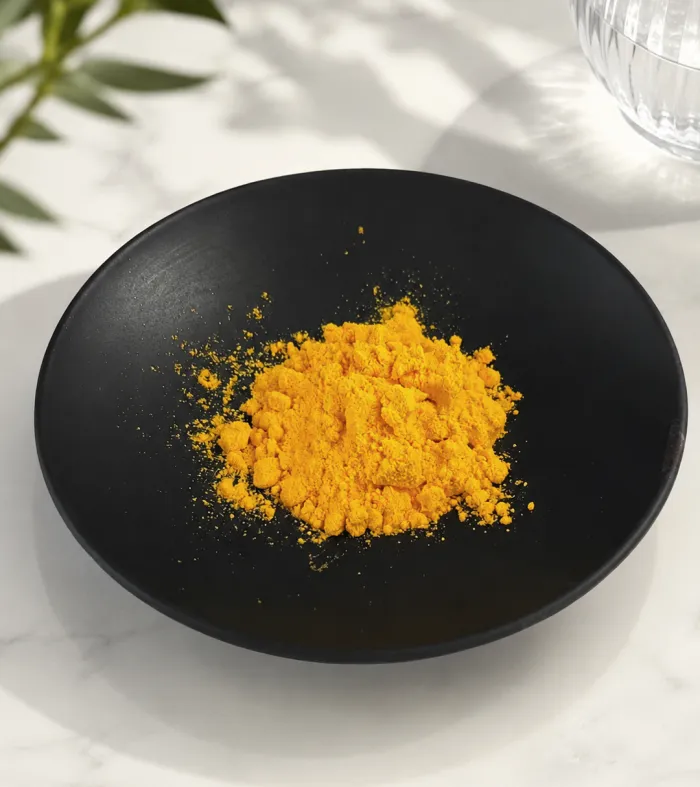
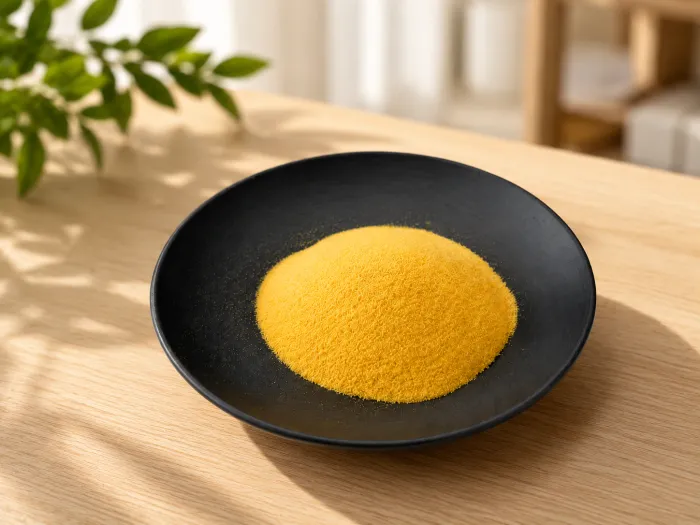
CoQ10 CWS uses microencapsulation and emulsification technology to convert lipophilic CoQ10 into a dry, water-dispersible powder. The objective is not to change the identity of CoQ10, but to improve its formulation behavior, ingredient protection and application flexibility.
Ubiquinone vs. Ubiquinol: Two Forms of CoQ10
CoQ10 occurs mainly as ubiquinone (oxidized CoQ10) and ubiquinol (reduced CoQ10). Both forms participate in the body's redox cycle and can interconvert in vivo. Rather than treating one form as universally superior, product developers should evaluate the target market, dosage form, stability requirements, regulatory status and supporting evidence for the specific project.
Consideration | Ubiquinone | Ubiquinol |
Redox form | Oxidized | Reduced |
Formulation focus | Widely used; comparatively robust handling | Greater sensitivity to oxidation |
Selection basis | Market, delivery format, stability and evidence | Market, delivery format, stability and evidence |
Why Conventional CoQ10 Is Challenging in Water-Based Formulations
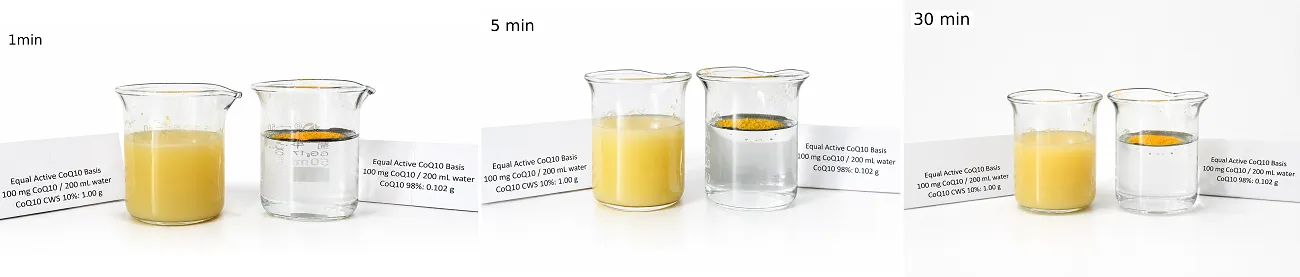
CoQ10 is highly lipophilic. In a simple water system, conventional crystalline CoQ10 may show poor wetting, floating, aggregation or sedimentation. These physical limitations can complicate its use in instant beverages, liquid nutrition products and other aqueous formulations.
Poor cold-water dispersibility
Risk of floating or visible agglomeration
Limited compatibility with water-based product formats
Sensitivity to formulation and storage conditions
Need for controlled particle properties in dry blends and solid dosage forms
How CoQ10 CWS Microencapsulation Works
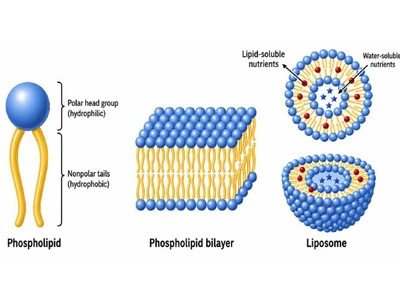
In the delivery system described in the technical material, CoQ10 is emulsified into fine oil droplets and incorporated into a water-compatible polymer matrix to form an oil-in-water (O/W) structure. Drying then converts the emulsion into a uniform microencapsulated powder.
This approach is designed to improve cold-water dispersibility and powder handling while physically protecting the lipophilic active from parts of the external environment.
Key Advantages of CoQ10 CWS
Improved Cold-Water Dispersibility
The CWS format is designed to disperse more readily in cold water than conventional crystalline.
Stability for Commercial Formulation
The technical material reports stability for up to 24 months at 25°C under the specified storage conditions. Applicable shelf life should be confirmed against the final product specification and batch documentation.
Processing-Friendly Powder Properties
Uniform particle distribution and good flowability can support blending and manufacturing in tablets, instant powders, emulsions and hard capsules.
Multiple Concentrations and Particle Formats
The technical material lists 1%, 10%, 20% and 40% CoQ10 grades. Spray-drying and double-coating fluid-bed processes can provide different particle-size distributions from fine powders to granulated formats.
CoQ10 CWS vs. Conventional CoQ10
Applications for CoQ10 CWS
Application | Why CWS Can Help | Key Evaluation Point |
Powdered beverages | Improved dispersion during reconstitution | Wetting, sedimentation, taste and color |
Functional drinks / shots | Greater compatibility with aqueous systems | pH, standing stability and processing |
Tablets | Dry powder handling and active protection | Flowability, compression and stability |
Hard capsules | Uniform dry blending | Flowability and blend uniformity |
Premixes / sachets | Easy incorporation into dry systems | Caking, segregation and re-dispersion |
Emulsion-based products | Delivery of a lipophilic active in an aqueous matrix | Emulsion stability and formulation compatibility |
What B2B Buyers Should Evaluate
Declared CoQ10 assay and batch-to-batch consistency
Ubiquinone or ubiquinol form and evidence for the specific grade
Cold-water dispersion under a defined test method
Wall-material / carrier system and label implications
Particle-size distribution, flowability and bulk density
Shelf-life and stability data under specified storage conditions
Performance in the actual product matrix, including pH and processing temperature
COA, specification, manufacturing information and market-specific documentation
Commercial scale, lead time and supply continuity
Frequently Asked Questions About CoQ10 CWS
What does CWS mean in CoQ10 CWS?
CWS generally refers to Cold Water Soluble or Cold Water Dispersible. For microencapsulated CoQ10, “cold-water dispersible” is often the more technically precise description unless true solubility has been analytically demonstrated.
Is conventional CoQ10 water soluble?
No. CoQ10 is highly lipophilic and has very low compatibility with water. Conventional crystalline CoQ10 may therefore float, aggregate or sediment in a simple aqueous system.
How does microencapsulation improve CoQ10 formulation performance?
Microencapsulation converts the lipophilic active into a protected dry delivery system designed for better water dispersion, powder handling and broader application flexibility.
Does CoQ10 CWS improve bioavailability?
Improved dispersion can be relevant to oral delivery, but bioavailability claims should be based on pharmacokinetic or clinical data for the specific CWS formulation. Dispersion performance alone does not establish a quantified absorption advantage.
Which CoQ10 CWS concentrations are available?
The technical material lists 10%, 20% and 40% CoQ10 grades, with particle formats that can be adjusted through spray-drying and fluid-bed processing.
Which applications are suitable for CoQ10 CWS?
Potential applications include powdered beverages, functional drinks, premixes, tablets, hard capsules and emulsion-based systems. Final suitability should be verified in the complete formulation.
Developing a CoQ10 Product?
OriginBio supports CoQ10 delivery-system selection for beverage, powder, tablet, capsule and other nutrition applications. Share your target CoQ10 dose, finished-product format, processing conditions and target market, and our team can help evaluate an appropriate CWS concentration, particle format and application-testing plan.
Request a Sample Request Technical Data Discuss Your Application
OriginBio
A reliable one stop nutrition supplement contract manufacturing partner
 EN
EN
 fr
fr  de
de  ru
ru 








 Call us on:
  Email Us:
  Office Add: