Astaxanthin Microencapsulation: How Wall Materials Influence Stability, Dispersibility and Bioavailability
A practical review of polysaccharide-based astaxanthin ester microcapsules for functional food and supplement applications
Astaxanthin is a carotenoid with strong antioxidant activity and occurs naturally in sources such as Haematococcus pluvialis, salmon, shrimp and crab. Depending on its source and degree of esterification, astaxanthin may occur as free astaxanthin, monoesters or diesters. In Haematococcus pluvialis, astaxanthin is present predominantly in esterified forms.
Despite its functional value, astaxanthin ester is poorly water-soluble and sensitive to environmental stresses. Microencapsulation provides a practical formulation strategy by embedding the active material within a protective wall matrix. This can improve dispersibility and storage stability and may also influence digestion and absorption behavior.
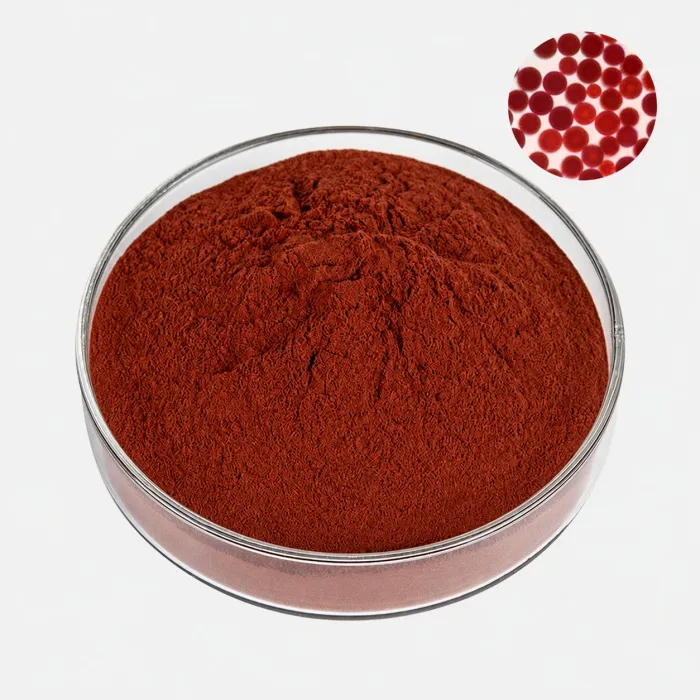
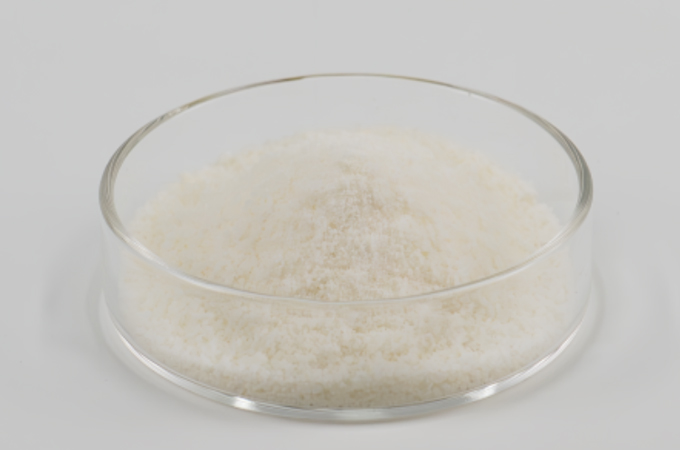
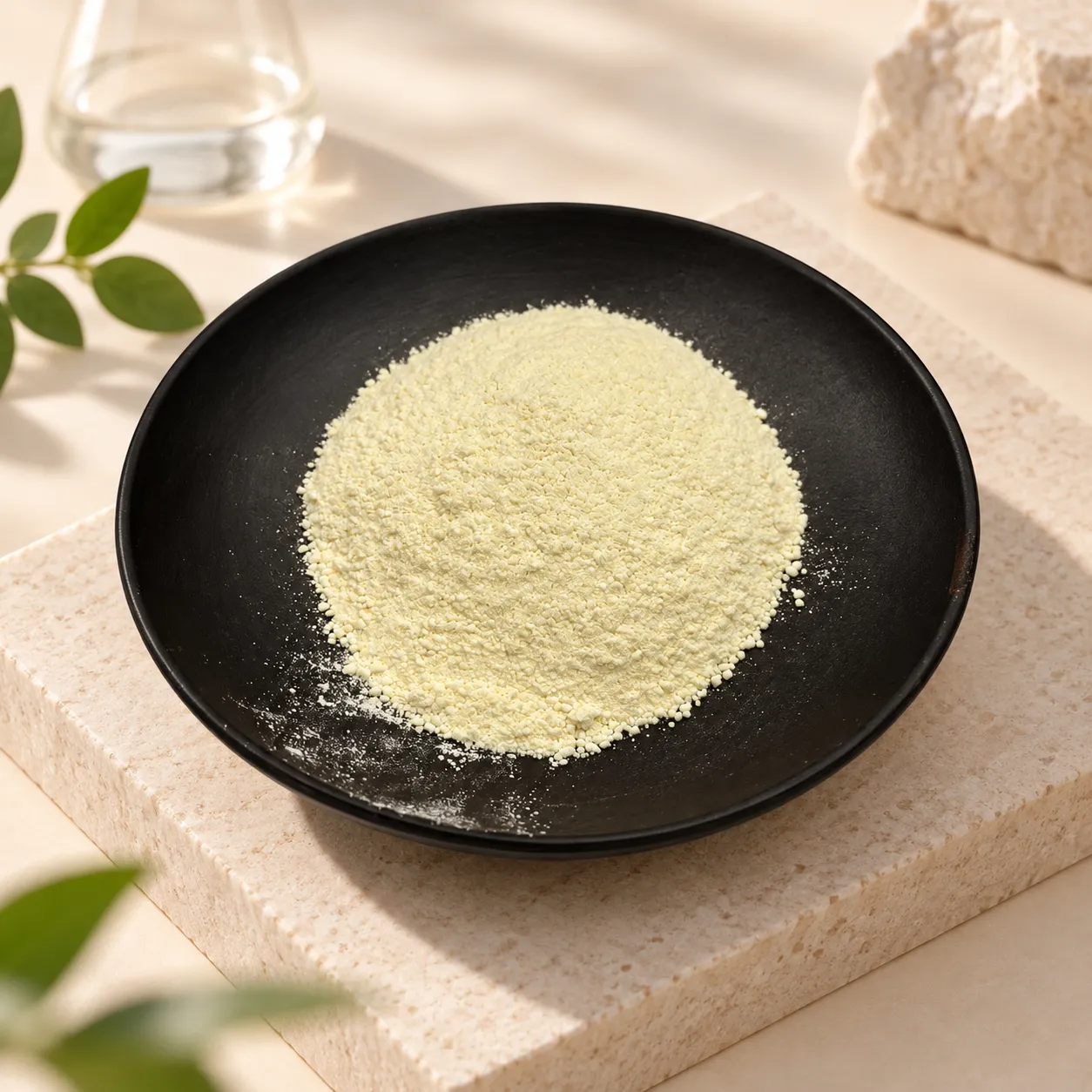
Astaxanthin microencapsulated powder
Why Microencapsulate Astaxanthin?
Microencapsulation surrounds an active ingredient with a protective wall material to form small particles. For astaxanthin, the technology is particularly relevant because the wall system can help isolate the core material from heat, light, oxygen and other external stresses while making an oil-soluble active easier to handle in powdered applications.
For functional foods, beverages and dietary supplements, the practical objective is not simply to produce a microcapsule. The formulation must balance encapsulation efficiency, particle size, powder flow, water dispersibility and stability.
Four Polysaccharide Wall Materials Evaluated
Polysaccharides are attractive wall materials because of their biocompatibility, biodegradability and diverse functional groups. Four polysaccharide systems:
Fucoidan: a natural polysaccharide derived from brown algae, valued for film-forming and hydrogel-forming properties that can support a stable protective structure.
Arabic gum: a traditional food-grade polysaccharide with emulsifying and stabilizing properties that can improve dispersion of astaxanthin ester in aqueous systems.
Inulin: a naturally occurring fructan polymer with high water solubility, relatively low viscosity and gel-forming capability, making it a candidate wall material.
Chitosan: a polysaccharide with bioadhesive and controlled-release characteristics that can be used to build dense microcapsule structures.
Encapsulation Efficiency: A Key Formulation Metric
Encapsulation efficiency indicates how effectively the wall material retains the core material. In the reported spray-drying study, the Arabic gum–astaxanthin ester system reached an encapsulation efficiency of 96.64 ± 0.33%, illustrating how strongly wall-material selection can affect the encapsulation result.
However, a high encapsulation efficiency alone does not guarantee the best finished ingredient. Particle morphology and storage stability also need to be considered.
Particle Size, Flowability and Dispersibility
Across the four polysaccharide-based systems, particle sizes were mainly reported in the micrometer range. Arabic gum–astaxanthin ester microcapsules showed the largest particles at approximately 20–30 µm, while inulin-based particles were the smallest, approximately 2–10 µm. Chitosan- and fucoidan-based systems fell between these ranges.
Smaller particles can support faster dispersion or dissolution of powdered oil systems and may be advantageous in solid beverage applications. But there is a trade-off: excessively small particles can reduce powder flowability and increase the tendency to agglomerate.
Particle shape is another practical factor. More regular particles generally flow more easily, while irregular, damaged or highly adhesive particles can compromise handling and dispersion during downstream manufacturing.
SEM Morphology: What the Microcapsules Look Like
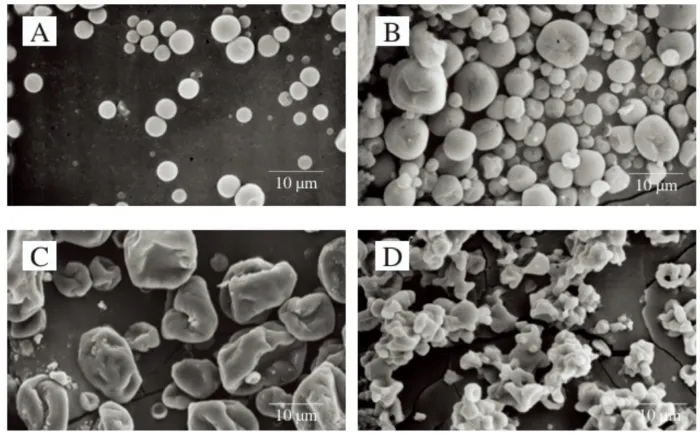
Figure 1. SEM morphology of polysaccharide-based astaxanthin ester microcapsules. A. Inulin; B. Fucoidan; C. Arabic Gum; D. Chitosan.
The microscopic morphology differed substantially among the wall systems. Inulin-based microcapsules showed intact, spherical particles with smooth surfaces and no obvious cracks. Fucoidan-based particles were approximately spherical and dense, with slight wrinkles and depressions. Arabic gum particles showed more pronounced surface depressions, irregular shapes and some surface rupture. Chitosan particles exhibited adhesion between particles, but their walls remained relatively intact and dense with few obvious cracks.
These observations are important because a dense, intact microcapsule wall generally provides a stronger physical barrier, whereas severe surface collapse or rupture can reduce the protective effect of encapsulation.
Thermal Stability: Microencapsulation Provides a Clear Protective Effect
Astaxanthin stability is influenced by internal factors such as core-to-wall ratio, wall thickness, density and integrity, as well as external factors including temperature, light and atmosphere. Light and oxygen exposure can be reduced through light-protective packaging and inert-gas strategies, but thermal degradation during storage and transportation remains an important shelf-life consideration.
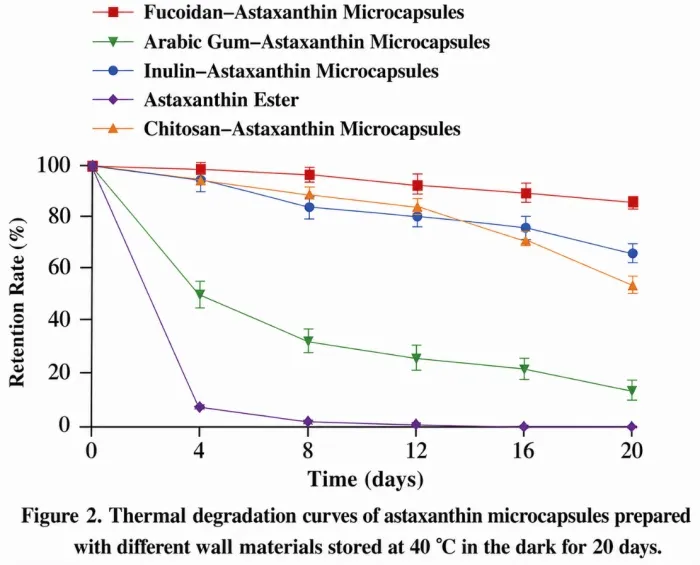
Figure 2. Thermal degradation curves of astaxanthin microcapsules prepared with different wall materials and stored at 40 °C in the dark for 20 days.
In the reported accelerated storage comparison, the unencapsulated astaxanthin ester control declined sharply by day 4. All four polysaccharide-based microcapsule systems showed substantially better retention than the unencapsulated control.
After 20 days, the highest retention for the fucoidan-based system at 86.55 ± 2.12%, followed by inulin at 66.97 ± 3.86% and chitosan at 56.66 ± 3.24%. The results reinforce a practical formulation principle: wall-material chemistry and particle integrity can materially influence the thermal protection delivered by microencapsulation.
How Microencapsulation May Influence Astaxanthin Bioavailability
Astaxanthin ester is not water-soluble. During digestion, it must first be emulsified by bile salts before interacting with digestive enzymes and being converted toward forms that can enter systemic circulation. Polysaccharide-based microcapsules can disperse into smaller droplets in aqueous environments, potentially improving contact with the digestive system.
Improved bioavailability-related pharmacokinetic parameters for several microencapsulated systems compared with unencapsulated astaxanthin ester. Digestion and absorption remain complex processes and can also be influenced by gastrointestinal stability, controlled release, intestinal residence time, hydrolysis and membrane transport.
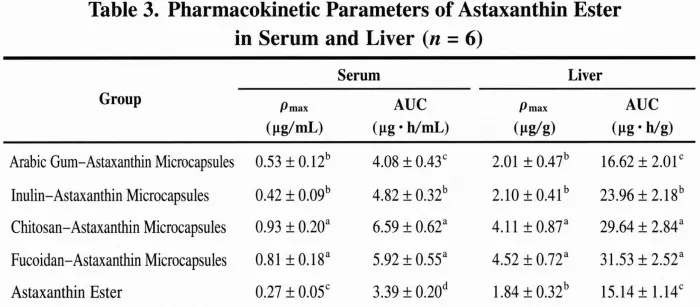
Table 3. Pharmacokinetic parameters of astaxanthin ester in serum and liver (n = 6)
What Does This Mean for Product Development?
The data highlight why wall-material selection should be treated as a formulation decision rather than a simple carrier choice. A wall material that delivers excellent encapsulation efficiency may not necessarily provide the strongest thermal stability, best morphology or most suitable powder handling characteristics.
For commercial astaxanthin powders, formulators should therefore evaluate the complete performance profile: encapsulation efficiency, particle size distribution, surface morphology, flowability, dispersibility, active retention during storage and application-specific stability.
Applications for Microencapsulated Astaxanthin
Functional beverage and solid-drink powders
Sachets and stick packs
Capsules and tablets
Premixes and multi-ingredient blends
Healthy-aging, beauty-from-within and antioxidant-positioned supplements
The most appropriate specification will depend on the finished dosage form, processing conditions, target active level and required shelf-life performance.
Key Questions to Ask an Astaxanthin Microcapsule Supplier
What is the astaxanthin source and active specification?
What wall materials and carriers are used?
What is the encapsulation efficiency?
What are the particle size and bulk-density specifications?
How does the powder perform in water or the intended application matrix?
What stability data are available under heat, light and storage conditions?
What analytical methods are used to verify astaxanthin content and retention?
Are application samples and supporting technical documents available?
OriginBio
A reliable one stop nutrition supplement contract manufacturing partner
 EN
EN
 fr
fr  de
de  ru
ru 








 Call us on:
  Email Us:
  Office Add: