Liposomal Berberine HCl vs. Regular Berberine: What's The Difference?
What's the real difference between standard berberine and liposomal berberine HCl? Tech for delivery is the short answer. Regular berberine is an alkaloid that comes from raw plants and is notoriously hard to absorb through the mouth. Liposomal berberine HCl, on the other hand, wraps the same active ingredient in phospholipid layers, making it more like the way the body's cell membranes are built. This new discovery changes berberine's actions in a big way once it gets into the digestive system. This difference is important to know whether you're a supplement brand, a contract maker, or a product creator if you want to make goods that really work.
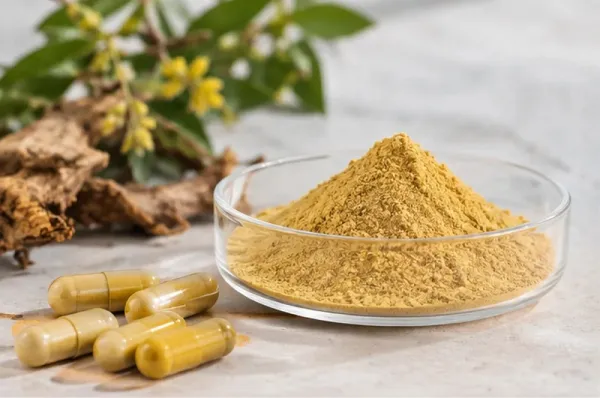
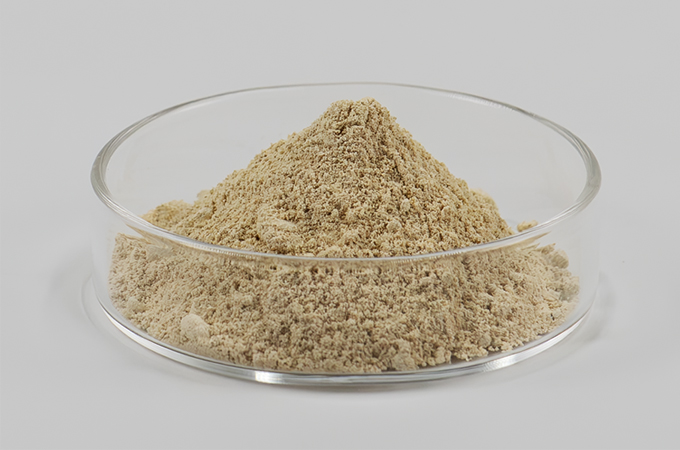
liposomal-berberine-hcl-50-powder
Key Differences Between Liposomal and Regular Berberine
What Does Regular Berberine Mean?
Berberine is a quaternary isoquinoline alkaloid that comes from plants. It has many biological activities, such as being an antioxidant and lowering blood sugar and cholesterol levels. It is mostly taken from plants like Coptis chinensis and Berberis aristata, which have a long history in Ayurvedic and traditional Chinese medicine. As it is, berberine is usually changed into a solid hydrochloride salt (berberine HCl) to make it easier to dissolve in water. However, its therapeutic potential is mostly limited by how poorly it is absorbed by the body when taken by mouth.
What Does Liposomal Berberine HCl Mean?
Liposomal Berberine HCl 50% is a new type of nutraceutical that is made to be as bioavailable and cellularly absorbable as possible. Traditional berberine doesn't always work well because it's hard for the body to absorb. Advanced liposomal delivery technology puts pure Berberine Hydrochloride inside phospholipid layers. This makes it possible for up to 5-10 times more absorption than with regular berberine powders or capsules.
What Makes The Core Difference?
At the molecular level, the main difference can be seen. Regular berberine particles are not protected and can be broken down by enzymes, bile acid, and intestinal efflux pumps. Each particle of liposomal berberine is surrounded by a phospholipid bilayer, which has a shape very similar to the membrane of a human cell[1]. The prepared system is lipophilic, which is similar to the structure of bio-membrane, and its small size makes it easier for it to get into the gut. The design is what makes the difference in how well the patients do.
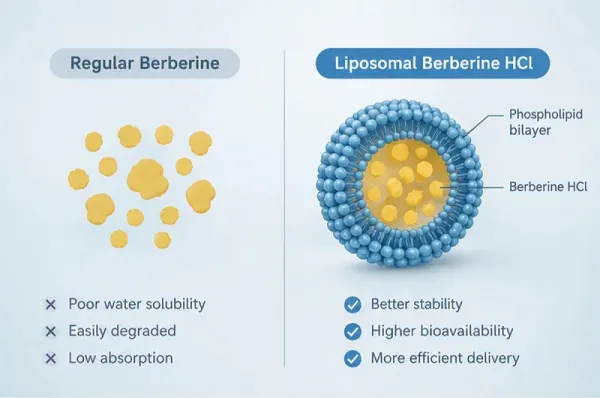
liposomal berberine vs regular berberine
Bioavailability: What Does the Research Show?
The Absorption Problem With Standard Berberine
The problem with conventional berberine's bioavailability is well known and important. The absolute bioavailability was only 0.68% and 0.36% in two preclinical studies. These studies found that the main barrier is intestinal first-pass metabolism, along with rapid hepatic extraction and distribution that also contributes to low systemic concentrations. In real life, this means that a lot of a normal dose of berberine is broken down before it gets into the bloodstream.
Human Pharmacokinetic Data on Liposomal Berberine
Recent clinical research paints a compelling contrast[2]. A pilot study compared the absorption, metabolic responses, and safety of a liposomal berberine formulation against standard unformulated berberine powder. Liposomal berberine produced significantly higher pharmacokinetic responses compared with unformulated berberine, including a 70.1% increase in Cmax (p = 0.03) and a 42.8% increase in AUC0-24 (p = 0.03).
Animal model data reinforces this trend. An in vivo bioavailability study using male Wistar rats demonstrated a 3.37-fold higher relative oral bioavailability compared to the unformulated berberine[3]. Simultaneously, the liposomal berberine demonstrated enhanced stability in the simulated gastric fluid in addition to a more sustained release in the simulated intestinal fluid.
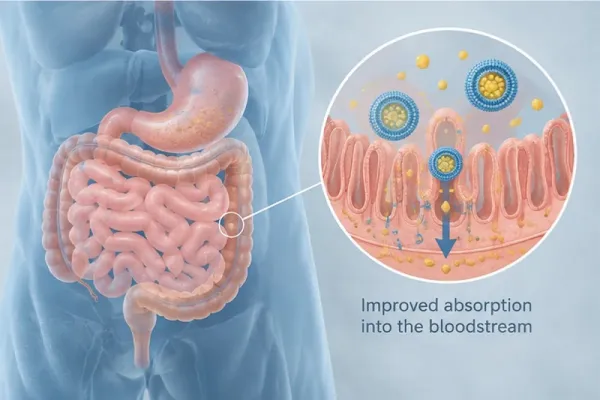
liposomal berberine bioavailability
Sustained Release and Tolerability Advantages
Beyond peak absorption, the liposomal vehicle changes the kinetics of delivery. The FIL formulation showed a sustained release of BBR at 59.03% compared to the unformulated control (46.73%) after 8 hours of dialysis. This slower, steadier release curve is particularly relevant for supplement brands targeting metabolic health applications, where consistent systemic exposure - rather than rapid spikes - is the desired outcome[3]. Liposomal delivery substantially enhances berberine absorption without negatively affecting metabolic or safety parameters in healthy male subjects.
Liposomal Berberine HCl 50% vs. 98%: How to Compare
Understanding the Purity Designation
Formulators often get confused by the percentage number that goes with berberine raw materials. The "50%" in liposomal berberine HCl does not mean the product is of lower quality; it just means that there is 50% more active berberine HCl in the liposomal complex. The rest of the mass is made up of the phospholipid carriers (mostly phosphatidylcholine from sunflower lecithin), the fillers, and the encapsulation matrix. A standard berberine HCl 98% is a very pure crystalline extract that doesn't have any extras added to it for delivery.
Why 50% Liposomal Can Outperform 98% Standard?
For many buyers, this idea goes against what they think. The number 98% pure tells you about the quantity of chemicals, not how biologically available they are. Using advanced liposomal encapsulation makes berberine much more bioavailable, which means it is absorbed better and stays active in the body longer. With this delivery system, lower doses can help glucose metabolism, lipid balance, and gut health more effectively. Because of this, a smaller amount of liposomal berberine HCl 50% may get more of the active compound to the tissues it's meant for than a much larger amount of 98% standard extract.
Table 1: Specifications at a Glance
Parameter | Liposomal Berberine HCl 50% | Standard Berberine HCl 98% |
Active Berberine Content | ≥ 50% | ≥ 98% |
Delivery System | Phospholipid liposome | None |
Particle Size | < 200 nm | Variable (micron range) |
Water Dispersibility | High | Moderate |
Relative Bioavailability | Significantly enhanced | Baseline |
Typical Dose Required | Lower | Higher |
Shelf Life | 24 months | 24–36 months |
Key Certifications | FDA, ISO, Halal, Kosher | ISO, Halal, Kosher |
Formulation Compatibility and Application Options
Delivery Form Versatility
One of the genuine advantages of liposomal berberine HCl from a product development perspective is its broad formulation versatility. OriginBio's liposomal berberine HCl 50% is compatible with delivery forms including softgels, capsules, liquids, and powders, with a particle size below 200 nm and water-dispersible solubility profile. This opens the door to a wide range of product categories beyond the traditional capsule - including liquid drops, stick packs, functional beverages, and chewables.
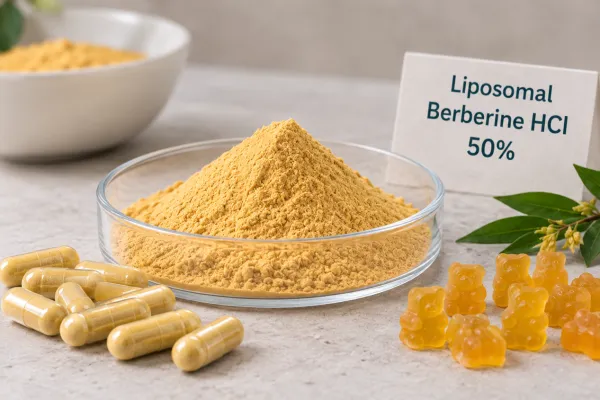
liposomal berberine HCL 50 product
Synergistic Stack Formulations
Liposomal berberine naturally works with metabolic ingredients that work well together. Gudmar (Gymnema), Cinnamon, and Bitter Melon are just a few of the ingredients that have been added to liposomal berberine formulas to support metabolic wellness on a regular basis. A multi-ingredient transport system within a single phospholipid vehicle may be possible thanks to the liposomal matrix's ability to co-encapsulate lipophilic actives. This is very appealing for softgel makers who are making products for managing blood sugar, lipids, and heart health.
Table 2: Applications by Market Segment
Target Market | Recommended Formulation | Format |
Blood Sugar Management | Liposomal Berberine 500 mg | Softgel / Capsule |
Metabolic Wellness Complex | Berberine HCl + Curcumin (liposomal) | Softgel |
Sports & Performance | Berberine + NAD⁺ Liposomal Complex | Capsule |
Rapid Absorption Products | Liposomal Berberine Liquid (250 mg/serving) | Liquid / Drops |
Cardiovascular Support | Berberine HCl + CoQ10 (liposomal) | Softgel |
Clean-Label and Certification Considerations
Liposomal berberine HCl at 50% purity is ideal for use in blood sugar, weight management, and heart health supplements that require high performance with clean-label appeal. Certifications such as Non-GMO, Gluten-Free, Vegan, Kosher, and Halal are achievable and are increasingly demanded by global retail buyers. Brands operating in regulated markets (EU, US, ANZ) should confirm that the supplier's liposomal carrier system - particularly the phospholipid source - meets regional labeling requirements.
How to Choose a Reliable Bulk Berberine Supplier
Verify Manufacturing Standards
The difference between a compliant and a non-compliant liposomal ingredient often comes down to manufacturing environment. For liposomal berberine HCl, particle size consistency (target: sub-200 nm) is only achievable through precision manufacturing equipment and tightly controlled processing conditions. Look for suppliers operating under cGMP standards, with a clean-room production environment and documented quality management systems such as ISO 9001 and HACCP certification.
Demand Full Specification Transparency
A credible supplier will readily provide a complete Certificate of Analysis (CoA) covering assay by HPLC, particle size distribution, heavy metals panel (Pb, Hg, Cd, As), microbiological safety, and moisture content. Referencing the OriginBio liposomal berberine HCl 50% specification as a benchmark, key parameters include an assay of ≥50% berberine HCl, total heavy metals below 10 ppm by ICP-MS, total plate count under 1,000 CFU/g, and absence of E. coli and Salmonella.
Evaluate Private Label and MOQ Flexibility
Not every supplement brand operates at scale. A capable supplier should be able to accommodate low minimum order quantities (MOQ) without sacrificing quality or regulatory support. At OriginBio, clients across all business sizes gain access to integrated one-stop services - from raw material sourcing and liposomal ingredient supply through to finished product contract manufacturing, packaging, and regulatory documentation. This end-to-end model eliminates the complexity of managing multiple vendors across the supply chain.
Ask About Sampling Before Committing
Sampling is non-negotiable when evaluating a new liposomal ingredient. A serious supplier will offer both raw material samples and finished-dose prototypes. This allows your R&D or quality assurance team to independently verify encapsulation efficiency, dispersion behavior in relevant formulation vehicles, and organoleptic properties before committing to a production run.
Conclusion
The difference between liposomal berberine HCl and regular berberine HCl is not just a matter of appearance; it shows a major change in how the active compound works with the body. Liposomal coating increases uptake, prolongs release, and improves tolerance, as shown by both clinical and experimental evidence. Supplement brands and people who buy ingredients should choose liposomal berberine HCl 50% because it makes products that work better. Because people are learning more about solubility, the need for more advanced delivery methods will only grow.
FAQ
Q1: What does the "50%" in liposomal berberine HCl 50% actually mean?
The 50% denotes the concentration of active berberine hydrochloride within the liposomal complex. The balance is made up of the phospholipid encapsulation matrix. Despite the lower percentage versus a 98% standard extract, the liposomal form delivers substantially higher bioavailability due to its advanced delivery architecture.
Q2: Is liposomal berberine HCl safe for long-term use in dietary supplement formulations?
Current clinical evidence indicates that liposomal berberine is well tolerated, with no significant adverse effects on metabolic or safety markers observed in human studies. That said, formulators should follow regional regulatory guidelines and include appropriate usage directions on finished product labels.
Q3: Can liposomal berberine HCl 50% be combined with other active ingredients in the same formulation?
Yes. Liposomal berberine HCl is highly compatible with co-ingredients such as curcumin, CoQ10, NAD⁺, cinnamon, and alpha-lipoic acid. The phospholipid matrix can often co-encapsulate lipophilic actives, making it a versatile base for multi-ingredient metabolic and cardiovascular health formulations.
Work With OriginBio - Your Trusted Liposomal Berberine HCl Manufacturer & Supplier
Ready to develop a high-performance berberine supplement? OriginBio is a GMP-certified liposomal berberine HCl manufacturer, supplier, and private label factory serving brands globally. From raw ingredient supply to finished product, we handle it all.
Contact us today: sales@originbionutra.com
OriginBio
A reliable one stop nutrition supplement contract manufacturing partner
 EN
EN
 fr
fr  de
de  ru
ru 








 Call us on:
  Email Us:
  Office Add: