Liposomal Technology: A Cross-Industry Revolution Reshaping Nutritional Delivery
Liposomal technology, originally developed for pharmaceutical use, is now emerging as a transformative direction within the nutraceutical industry - directly addressing the longstanding absorption challenge in conventional supplements and offering brands a meaningful technological edge. As consumer expectations around supplement efficacy continue to rise, liposomal delivery is rapidly shifting from a niche innovation to a mainstream formulation strategy.
Liposome Structure and Classification
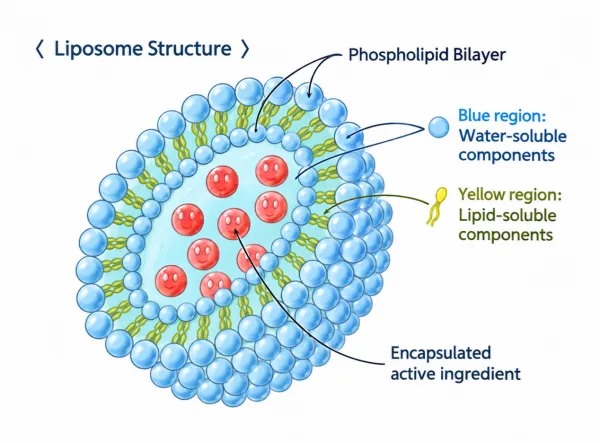
Liposomes are small membrane vesicles composed of lipids with both hydrophobic and hydrophilic phases, enabling the stabilization and sustained release of bioactive compounds[1].
Phospholipid molecules form the core structural component. Cholesterol, lecithin, and nonionic surfactants are commonly incorporated to enhance membrane stability. Natural phospholipid sources widely used in liposome preparation include soy lecithin, egg yolk lecithin, marine lecithin, and milk lecithin, alongside synthetic variants such as dipalmitoylphosphatidylcholine (DPPC), distearoylphosphatidylcholine (DSPC), and dimyristoylphosphatidylcholine (DMPC).
When dispersed in an aqueous medium, phospholipids self-assemble into closed bilayer vesicles driven by hydrophobic interactions - hydrophilic head groups face outward toward the aqueous phase, while hydrophobic tails are sequestered within the bilayer interior. This unique configuration allows hydrophilic substances to be entrapped in the internal aqueous core, while hydrophobic substances embed within the bilayer itself, enabling the simultaneous encapsulation of both types of active ingredients[2].
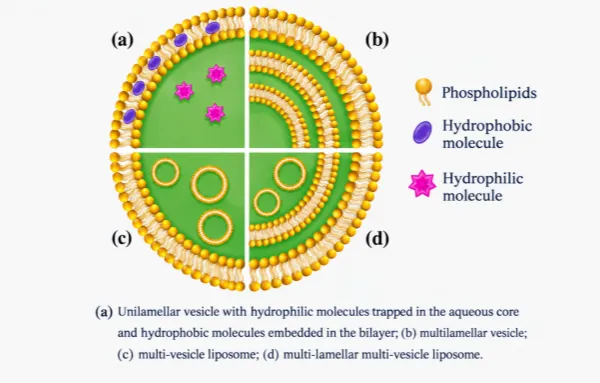
Based on particle size and the number of bilayers, liposomes are classified into three primary types:
Unilamellar Vesicles (ULV): SUV (30-100 nm), LUV (100-300 nm), GUV (1-100 μm)
Multilamellar Vesicles (MLV): multiple concentric bilayer membranes arranged in an onion-like structure
Multivesicular Vesicles (MVV): multiple smaller vesicles encapsulated within a single larger outer vesicle
Liposomal Technology: A Paradigm Shift in Nutritional Delivery
Sharing the same phospholipid material as human cell membranes, liposomes are uniquely positioned to protect encapsulated actives from gastric acid and enzymatic degradation while facilitating targeted delivery to specific tissues and cells[3]. Research confirms that the human body absorbs liposomal ingredients more effectively, and multiple actives can be co-loaded within a single vehicle for synergistic action[1].
Three core delivery advantages set liposomes apart from conventional nutritional systems:
1. Digestive Protection: The phospholipid shell forms a natural protective barrier, effectively shielding active ingredients from gastric acid erosion and enzymatic hydrolysis, maintaining ingredient integrity throughout gastrointestinal transit[4].
2. Targeted Delivery: Structural homology with cell membranes enables liposomes to directly recognize tissue cells and deliver nutrients with precision, significantly reducing losses during transport.
3. Dual-Payload Capacity: The amphiphilic molecular architecture — hydrophilic heads and hydrophobic tails — allows simultaneous encapsulation of both water-soluble and fat-soluble compounds within a single delivery vehicle, transcending the compatibility constraints of conventional systems[2].
Conventional Nutrients vs. Liposomal Nutrients
Conventional nutrients must navigate a demanding sequence of barriers — degradation by gastric acid and enzymes, transporter protein saturation, and hepatic first-pass metabolism — each stage reducing the proportion of active compound that ultimately reaches systemic circulation. Liposomal nutrients bypass many of these obstacles entirely.
Table 1: Comparison of Absorption Rates: Conventional Nutrients vs. Liposomal Nutrients
Stage | Conventional Nutrients | Liposomal Nutrients |
Gastric Transit | Unprotected; approximately 50% of a 1,000 mg vitamin C dose is degraded before leaving the stomach | Phospholipid bilayer encapsulates actives in 50-150 nm vesicles; passes through stomach fully intact |
Intestinal Absorption | Water-soluble nutrients limited by transporter saturation; fat-soluble absorption can fall as low as 1-3% without adequate bile | Membrane fusion and endocytosis bypass transporter limits; absorption up to 34× higher at 64 nm particle size |
First-Pass Metabolism | Portal vein → hepatic CYP450 clearance; typically only 5-30% of oral dose reaches systemic circulation | Chylomicron → lymphatic system → thoracic duct; bypasses liver, achieving higher peak plasma concentration and prolonged systemic residence |
Studies demonstrate that liposomal vitamin C produced via high-pressure microfluidization achieves encapsulation efficiency exceeding 80%, with bioavailability substantially improved in simulated in vitro gastrointestinal digestion models[5].
Commonly Used Liposomal Ingredients in Food Supplements
Liposomal Vitamins
Liposomal resolve the core absorption limitations of both water-soluble and fat-soluble vitamins - addressing short intestinal transit time, poor solubility, and rapid degradation. This approach enhances both in-vivo stability and sustained delivery across multiple dosage formats, including tablets, capsules, and solid beverages. Current commercial categories include liposomal vitamin C, vitamin D, glutathione, melatonin, and lactoferrin[6].
Liposomal Minerals
Targeting the well-known challenge of mineral precipitation and chelation within the gastrointestinal tract. By encapsulating minerals within a phospholipid matrix, interactions with gastrointestinal components are minimized, improving dispersibility and absorption efficiency. Equally important, liposomal encapsulation significantly reduces metallic taste and astringency, enhancing palatability and consumer compliance.
Liposomal Botanical Extracts
Liposomal overcome the core limitations of plant-derived bioactives — poor water solubility, low intestinal permeability, and rapid metabolic clearance — through encapsulation that improves both stability and bioavailability. Research data indicate that cocoa procyanidin dimers, trimers, and tetramers showed 4.5×, 2.1×, and 9.3× improvements in bioaccessibility respectively following liposomal encapsulation.
Liposomal Peptides
Liposomal encapsulation protect peptide-based actives from enzymatic degradation in the gastrointestinal tract, preserve their biological activity, and promote cellular uptake — enabling the body to more efficiently utilize the nutritional benefits of peptides. This makes liposomal encapsulation particularly valuable for delivering high-bioavailability glutathione formulations with superior organoleptic properties.
Key Manufacturing Considerations
Translating liposomal technology into consistent, high-performance commercial products requires precision across several critical dimensions — from raw material selection through to stability management and regulatory compliance.
Phospholipid Raw Material Quality
Phosphatidylcholine (PC) content directly governs membrane integrity and encapsulation efficiency — higher PC content translates to greater membrane density and structural stability. Natural and synthetic phospholipids differ significantly in oxidative stability and regulatory classification; all materials require complete CoA documentation covering PC purity, acid value, peroxide value, and heavy metal content.
Table 2: Process Route Selection
Method | Advantages | Key Considerations |
Thin-Film Hydration | High EE%; well-controlled particle size | Difficult to scale without extrusion homogenization |
High-Pressure Homogenization | Industrial-scale compatible; narrow particle size distribution | High equipment investment; precise parameter control required |
Spray Drying | Enables dry powder liposomes; broad dosage form compatibility | Requires lyoprotectants (e.g., trehalose) to prevent vesicle aggregation |
Supercritical CO₂ | No organic solvent residue; well-suited to heat-sensitive actives | High equipment cost; primarily applied to high-value categories |
Particle Size
Food-grade liposomes should target a particle size of 50-200 nm and Zeta potential > 30 mV (absolute value). These parameters collectively ensure batch-to-batch uniformity, colloidal stability, and optimal intestinal permeability.
Stability Management
Liquid liposomes require cold-chain storage at 2-8°C, protected from light and oxidation. Converting to powder form via spray drying or freeze-drying extends shelf life to 12-24 months. Incorporating tocopherol as a natural antioxidant inhibits phospholipid oxidation, while maintaining an internal pH of approximately 6.9 supports long-term stability and minimizes active ingredient leakage.
Regulatory Compliance
EU markets require EFSA Novel Food notification for nanomaterial applications; US products must conform to FDA 21 CFR food additive regulations. Phospholipid source — GMO or Non-GMO — must be accurately declared on product labels. Clean-label certifications including Non-GMO, gluten-free, vegan, Halal, and Kosher are increasingly expected by global retail buyers. All production facilities should operate under GMP-compliant cleanroom conditions, with ISO 9001 and HACCP certification strongly recommended to satisfy global buyer audit requirements.
Conclusion
Liposomal technology represents a fundamental restructuring of nutritional delivery logic — not merely an incremental formulation upgrade. Its application demonstrably enhances the stability, absorption efficiency, and bioavailability of bioactive compounds across vitamins, minerals, botanicals, and peptides. For supplement brands and ingredient procurement teams, a thorough understanding of liposomal science is increasingly a prerequisite for building genuinely high-performance, market-competitive product lines.
Partner With OriginBio
OriginBio is a GMP-certified liposomal ingredient manufacturer, bulk supplier, and private label factory serving nutritional supplement brands worldwide. We offer fully integrated one-stop services — from raw material supply and formulation development through to finished product contract manufacturing and regulatory support — with low MOQ to accommodate businesses of all sizes. Contact us at sales@originbionutra.com.
OriginBio
A reliable one stop nutrition supplement contract manufacturing partner
 EN
 fr
 de
 ru












 Call us on:
 Email Us:
 Office Add:
