Stick Packs, Sachets or Tubs: How to Choose Packaging for Powder Supplements
Powder supplement packaging affects more than shelf appearance. It determines how customers measure a serving, how easily they carry the product, how the powder is protected, and how much your brand spends on filling and distribution.
Stick packs usually suit portable, premeasured servings. Sachets offer a wider single-use format for sampling or larger portions. Tubs suit repeated use and larger powder quantities. The right choice depends on the formula’s physical properties, serving weight, storage requirements, and customer routine.
There is no universally superior format. A compact electrolyte powder and a bulky protein blend may require different packaging even when both are designed to mix into water.
What Is the Difference Between Stick Packs, Sachets and Tubs?
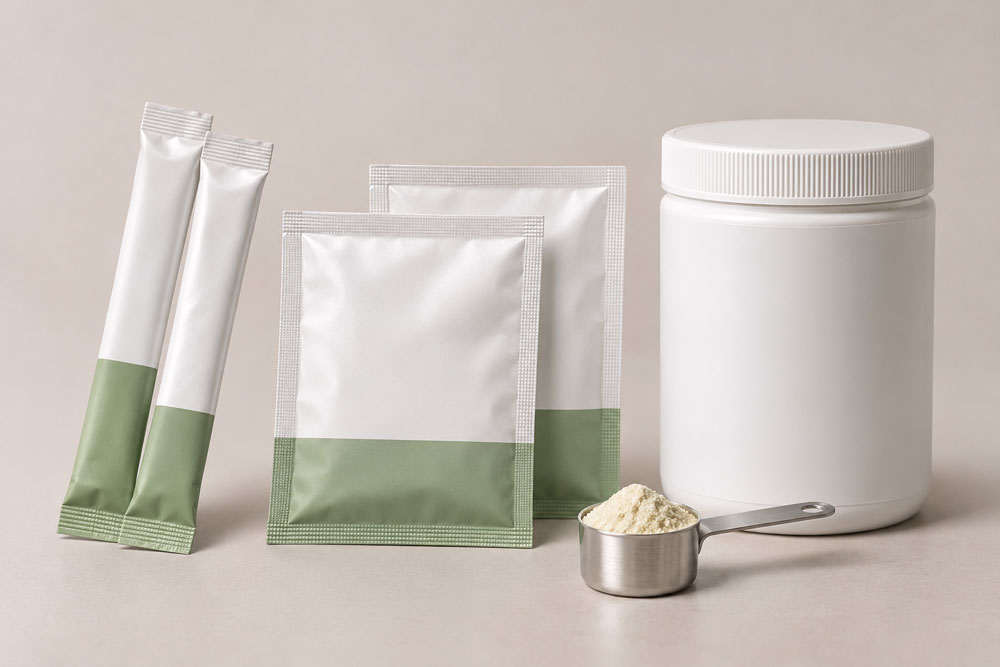
Stick packs are narrow flexible packets, sachets are generally wider flexible packets, and tubs are rigid containers designed to hold multiple servings.
Terminology varies between suppliers: a stick pack can also be described as a type of sachet. For a manufacturing quotation, specify the pack dimensions, fill weight, seal configuration, and intended use rather than relying on the format name alone.
Stick Packs: Portable, Premeasured Servings
Stick packs hold individual portions in a slim package. Customers tear the pack open and pour the powder into a glass, shaker, or bottle.
Their main advantage is convenience. Users do not need to carry a scoop or measure powder away from home. However, the opening and package width must suit the powder. A cohesive blend may pour poorly through a narrow opening, while a bulky serving may require an impractically long pack.
A premeasured pack also depends on controlled filling. Its shape alone does not guarantee accurate fill weight or uniform ingredient distribution.
Sachets: Wider Single-Use Packaging
Sachets typically provide a broader package face and opening than stick packs. This can make them useful for sample portions, promotional packs, or servings that need more room.
The wider surface may support clearer graphics and instructions, although actual labeling space depends on the finished dimensions and market requirements. Tear behavior, powder retention in corners, and seal cleanliness should all be checked using filled samples.
Tubs: Multiple Servings in One Container
Tubs hold a bulk quantity of powder, usually dispensed with a scoop. They can suit customers who use the product regularly at home or in a gym.
A tub avoids individually wrapping every serving, but users repeatedly open the same container. Closure performance, storage behavior, and the period after opening therefore matter. Container size should reflect powder volume and filling requirements—not simply the desired visual impression.
OriginBio's powder supplement manufacturing services provide a starting point for assessing the formula and serving format together before packaging dimensions are finalized.
How Do Stick Packs, Sachets and Tubs Compare?
The most useful packaging comparison evaluates serving convenience, product protection, filling feasibility, and total cost on an equivalent quantity of supplement.
| Decision factor | Stick packs | Sachets | Tubs |
|---|
| Typical use | Portable individual servings | Individual servings, samples, or trial packs | Repeated use from a larger quantity |
| Customer measurement | Factory-portioned | Factory-portioned | Customer measures each serving |
| Portability | Compact; easy to carry separately | Portable; dimensions depend on serving volume | Usually less convenient for travel |
| Opening and pouring | Narrow opening needs checking | Wider opening may help some powders | Scoop access depends on neck width |
| Exposure during use | Each unopened portion remains sealed | Each unopened portion remains sealed | Remaining powder is exposed when opened |
| Filling considerations | Flow, dust, narrow seals, and fill volume | Flow, seal contamination, and packet size | Fill volume, settling, and scoop placement |
| Packaging cost drivers | Film, individual filling, printing, and cartons | Film area, filling, printing, and cartons | Container, lid, seal, scoop, and labeling |
| Common limitation | Bulky servings may be awkward | Larger packets may be less pocket-friendly | Measurement variation and repeated opening |
These are practical tendencies rather than fixed performance rankings. A well-sealed, suitable tub may protect a formula better than a flexible packet made from an unsuitable film.
Compare Serving Weight with Powder Volume
Packaging capacity depends on bulk density as well as weight.
For an illustrative 10 g serving, a powder with a bulk density of 0.50 g/mL occupies approximately 20 mL. At 0.25 g/mL, the same weight occupies approximately 40 mL.
Estimated powder volume = serving weight ÷ bulk density
These calculations exclude the additional space needed for filling, sealing, and powder movement. Actual trials should use the production-representative blend because density and flow can change with ingredient selection and processing.
This is why a pack suitable for one 10 g formula may be unsuitable for another.
Compare Cost per Serving
A tub and a carton of individual packets should be compared using the same formula weight and serving count.
For example, 30 servings × 10 g = 300 g of powder. A fair quotation compares one 300 g tub with 30 filled 10 g packets, including any outer carton.
Calculate:
Packaging and filling cost per serving = total packaging and filling cost ÷ saleable servings
Ask suppliers to identify printing setup, filling, containers or film, closures, scoops, cartons, testing, and expected production losses. Keep freight and warehousing assumptions consistent.
Do not assume flexible packaging always produces the lowest delivery cost. Final shipping volume depends on the complete retail and transport configuration. Likewise, packaging weight alone does not establish recyclability or overall environmental impact.
What Should You Check Before Approving Powder Supplement Packaging?
Packaging approval should confirm that the actual formula can be filled, sealed, stored, shipped, and used successfully in the proposed container.
Match the Barrier to the Formula
Start by identifying sensitivity to moisture, oxygen, light, and temperature. Relevant concerns may include clumping, flavor deterioration, loss of ingredient potency, or reduced probiotic viability.
Ask for the proposed material structure and relevant barrier data. Water vapor transmission rate and oxygen transmission rate must be compared under equivalent test conditions; values measured under different temperatures or humidity conditions may not be directly comparable.
USP General Chapter 〈671〉, Containers—Performance Testing, provides a technical reference for packaging performance, including moisture vapor transmission testing of plastic packaging systems. The appropriate method and its applicability should be established for the package concerned; this is not a universal testing mandate for every supplement format.
For tubs, assess the container, closure, and seal as a system. For flexible packs, assess the film and finished seals. A high-barrier material cannot compensate for a leaking seal.
Run Filling and Consumer-Use Trials
Evaluate the complete journey from filling to consumption.
For stick packs and sachets, check fill consistency, powder trapped in the seal area, tearing, leakage, and how much powder remains after pouring. For tubs, check powder settling, closure operation, scoop access, and dispensing consistency.
A scoop measures volume. Its delivered weight can vary with powder density, leveling, and compaction. Verify the proposed scoop with the actual blend rather than assuming a particular scoop volume equals the intended serving weight.
Consumer trials should also reflect the mixing instructions. A packet that opens easily but spills when poured into the intended bottle creates a preventable usability problem.
OriginBio's supplement packaging services support discussions about packaging materials, labeling, and filling arrangements. Request filled samples where feasible so that approval covers function as well as appearance.
Establish Specifications and Support Shelf Life
For products intended for the U.S. market, FDA's dietary supplement CGMP guidance explains requirements under 21 CFR Part 111, including specifications for packaging and labeling. Agree on relevant acceptance criteria before commercial production.
Shelf life should be supported by evidence relevant to the formula, packaging, and storage conditions. Do not automatically transfer a shelf-life claim from a sealed sachet to a repeatedly opened tub.
FDA's general dietary supplement labeling guidance states that expiration dating is not required on U.S. dietary supplement labels, but a date used voluntarily should be supported by valid data. Other markets may have different requirements.
Discuss the proposed package and any relevant use-after-opening conditions when requesting supplement stability testing support from OriginBio.
Confirm Labeling and Production Requirements
Review artwork at its actual printed size. Required information, directions, warnings, lot coding, and any date marking must remain legible.
For individually wrapped products, confirm the labeling requirements for both the packet and outer carton, especially if packets may be distributed separately.
Before requesting a quotation, define serving weight, servings per retail unit, destination market, order quantity, packaging preferences, and intended storage conditions. Ask the manufacturer to confirm minimum order quantities and schedules for the exact configuration rather than applying a general estimate across all formats.
Conclusion
The right powder supplement packaging combines convenient serving delivery with demonstrated product protection and workable production economics.
Choose stick packs when compact individual portions fit the customer routine. Consider sachets when a wider packet better accommodates the serving or sampling strategy. Evaluate tubs when customers need multiple servings from one container.
Before approving a format, compare filled samples, barrier specifications, filling performance, cost per serving, and shelf-life support. Send OriginBio your formula brief, serving weight, target market, expected volume, and preferred format to discuss a suitable packaging configuration and quotation.
FAQ
What is the difference between a stick pack and a sachet?
A stick pack is typically narrow and elongated, while a sachet is generally wider. Supplier terminology varies, so confirm dimensions, seal configuration, and fill capacity.
Are stick packs better than tubs for moisture-sensitive powders?
Individually sealed packs can limit exposure of unopened servings during use. Actual protection still depends on barrier properties, seal integrity, storage conditions, and the formula's sensitivity.
Can the same formula be sold in all three formats?
Sometimes, but each format requires feasibility review. Powder flow, serving volume, dispensing behavior, and stability support may affect whether the formula transfers successfully.
Which packaging format is cheapest?
There is no universal lowest-cost option. Compare complete packaging and filling costs per serving, including outer packaging, setup charges, production losses, and distribution.
How do I choose the correct tub size?
Use the intended net weight and measured bulk density to estimate powder volume, then confirm filling space and settling through trials. Check scoop access and practical handling before approval.
Do I need new stability evidence when changing packaging?
A packaging change should be assessed for its effect on product protection. Changes to barrier materials, closures, seals, or exposure during use may require additional evidence to support the proposed shelf life.
OriginBio
A reliable one stop nutrition supplement contract manufacturing partner
 EN
 fr
 de
 ru










 Call us on:
 Email Us:
 Office Add:
